# Dibbla — full site content
Every page of dibbla.com in one file, generated at build time from the same
markdown the site returns for `Accept: text/markdown`. See /llms.txt for a
linked index.
---
Source:
# Build with Claude.
Deploy with Dibbla. _Stay in control._
Dibbla runs the apps and agents you build with your code assistant of choice, with the access control, audit logging, and cost tracking your organization needs. Enterprise deployments run entirely in your own cloud or on‑premises.
[Start free with Hobby](https://app.dibbla.com/login?return_to=%2Fwelcome)
Deploy your first app in minutes.
## Pricing
### Hobby
€0
free, always · no card needed
For non-commercial use
- 1 user
- 3 apps, databases, storage buckets, workflows and tool servers
- 0.25 vCPU, 512 MB and 1 replica per app
- 1 GB per database and storage bucket
- Every deploy gets a code review
- Ready-made templates
[Start free with Hobby](https://app.dibbla.com/login?return_to=%2Fwelcome)
Most popular
### Business
€30
per user, per month · VAT included
Every member of your organization counts as a user
- No limits on apps, databases, storage buckets, workflows or tool servers
- Invite your team, with roles: owner, admin, developer, viewer
- Require sign-in to your apps, via Google or Microsoft Entra
- More CPU, memory and replicas per app
- AI Usage cost tracking
- Built-in support tickets
- Custom domains
[Start now](https://app.dibbla.com/login?return_to=%2Fupgrade)
### Enterprise
Custom
for regulated and large organizations
- Self-hosted: your cloud or on-prem
- EU data residency guarantees
- Security review support
- Dedicated onboarding
[Talk to sales](/enterprise)
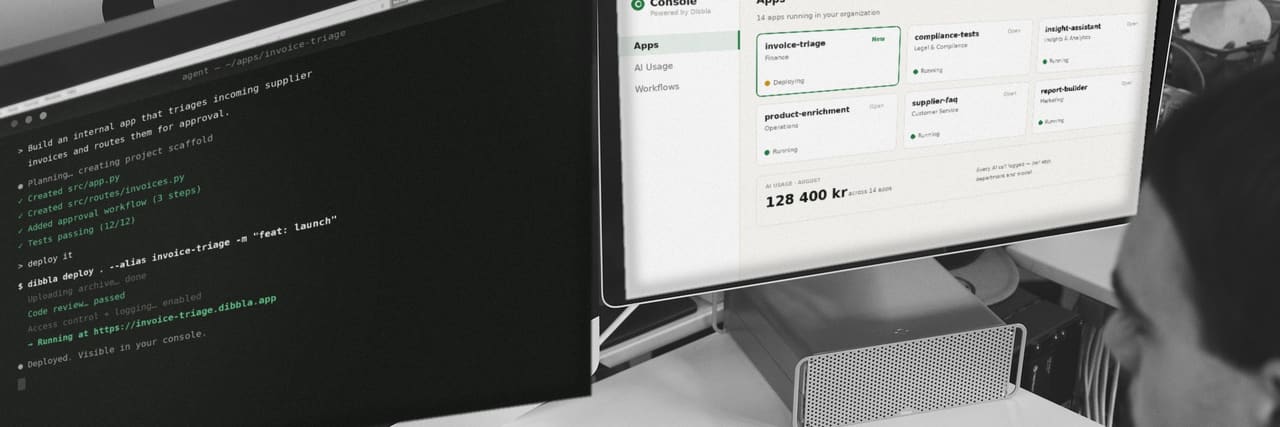

ConsolePowered by Dibbla
AppsAI UsageWorkflows
### Apps
Deploy
**14 apps running** in your organization
compliance-testsOpen ↗
Legal & Compliance
Running
insight-assistantOpen ↗
Insights & Analytics
Running
product-enrichmentOpen ↗
Operations
Running
invoice-triageOpen ↗
Finance
Deploying
AI Usage · August
€11,200across 14 apps
Every AI call logged, per app, department and model.
Trusted by teams at




















How it works
## From Claude prototype to a managed application in three steps.
1
### Build with Claude
Your teams build apps and agents with Claude, or any model. Start from ready-made templates for common business cases.
2
### Deploy in one step
One command or one click. Every deploy gets a code review before it ships, and runs with access control, logging and monitoring included.
3
### Supervise, don't staff
Every app, user and AI call visible in one console. Audit logs, cost tracking and guardrails from day one.
In production today
## Real deliveries, not demos.
Compliance at scale
### Every regulatory requirement, tied to a test that proves it
In a transaction-intensive business under heavy regulation, agents read the requirements, work out which test cases each one demands, generate the test code and link it back to the clause it satisfies. The evidence an audit needs is produced by the pipeline instead of assembled after the fact.
Product data
### A catalogue enriched on its way into a new PIM
A product database had to arrive in a new PIM carrying attributes the old system never held. Agents read supplier documentation, fill the gaps against the target schema and flag what a human has to decide, so the migration stops waiting on manual data entry.
Small team, full stack
### One builder, the whole delivery chain
A small company builds with the code assistant it prefers and ships through Dibbla. Git, database, deployment, access control and AI cost tracking sit in one place, with no separate toolchain to keep running. Governance is a property of the platform rather than a project someone has to staff.
Forward Deployed Engineers
## You don't have to build alone.
Dibbla's consulting team of Forward Deployed Engineers builds your first agentic applications with you, on the platform, in your environment. They specialize in agentic development, and in understanding where the value is and which ways of working need to change.
[Talk to us about a first project](#intro)
### Start with a real use case
A first application in production, not a slide deck. The use cases above were built this way.
### Learn by building together
Your team works alongside our engineers and owns the application from day one.
### Industry experience
Gaming, wholesale and highly regulated businesses, from iGaming compliance to product data at scale.
Built for scrutiny
## When someone asks "who did what, and what did it cost", you have the answer.
Audit log
Recent changes recorded in the audit log
Event
Subject
When
app deployed
compliance-tests · v14
Today 09:12
access granted
Finance · 3 users
Today 08:47
model changed
insight-assistant
Yesterday
secret rotated
product-enrichment
Yesterday
Every change logged with who, what and when.
AI Usage by department
AI spend per department this month
Department
Spend
Share
Operations
€5,400
▮▮▮▮▮
Legal & Compliance
€2,700
▮▮▮
Insights
€2,000
▮▮
Finance
€1,100
▮
Costs attributed per app, department and model. No more surprise invoices.
Why leadership chooses Dibbla
## AI adoption stalls on uncertainty. Remove it.
Your teams are already building with AI. The question is whether it happens in one governed place, or in a hundred ungoverned ones.
### See everything
Every AI app in your organization in one register, with an owner and a status.
### Control access
SSO and role-based access. The right people reach the right apps and data, nothing more.
### Prove compliance
Audit-grade logging and EU data residency, ready for GDPR reviews and security questionnaires.
### Control costs
AI spend attributed per app and department. Budget with real numbers, not estimates.
Claude-first. Works with every major model provider.
ClaudeOpenAIAzure OpenAISelf-hosted models
FAQ
## The things people ask us first.
What Dibbla is
What is Dibbla?
Dibbla is a platform for deploying, sharing and managing applications built with code assistants. It is the home for all the applications, AI agents, workflows, MCP servers, user interfaces, databases and other services that you or your colleagues create with code assistants. Dibbla is not a competitor to code assistants such as Claude Code, Claude Cowork, Codex, Gemini CLI and OpenCode. It complements them: you build with the assistant you prefer and ask it to deploy to Dibbla. A few minutes later the application is online and ready to share. Dibbla takes care of everything around it: code review, user documentation, hosting, databases, security and who is allowed to use the application.
Who is behind Dibbla?
We are a group of developers, management consultants and AI specialists who saw the potential of code assistants early on. We have seen that building the application itself is often the easy part; the hard part is deploying it, making it available to others and managing it safely. We saw platforms such as Lovable, Replit and Microsoft Power Apps begin to solve parts of this problem, but they require you to work their way. We wanted a platform where you can use Claude, Codex, Gemini, OpenCode or any other assistant together with the models and technologies you prefer.
Why did we build Dibbla?
Programming has become dramatically easier with coding agents, but the application still needs somewhere to run, a way to reach its users and a way to be managed over time. Alternatives such as Lovable and Replit are quick, but prescriptive: they lock you into their own assistant, technology choices and hosting. Dibbla lets individuals and companies build with the code assistants they prefer, then deploy and manage everything in one place, keeping control over how and where applications run.
Who is Dibbla for?
Both the person building an application and the person responsible for the company's IT. The builder wants to make what they have built available with as little friction as possible. The CIO, Head of IT or CTO wants visibility and control: what applications do we have, who can use them, what resources do they consume, how is AI used and what does it cost? Dibbla brings these answers together without dictating which code assistant employees must use, and gives builders guardrails such as code review before deployment, user documentation, resource control and access control. A company can also route AI usage through Dibbla to monitor and control costs; this is optional.
Why should I start using Dibbla?
You may already ask an AI assistant to build applications, but not know how to make them available to customers, suppliers or colleagues in a simple, secure way. Deploying one application is not a major problem. But once AI use takes off, a company will not have one or two applications: it will have hundreds of apps, databases, AI agents, workflows and interfaces. Managing them will require considerably more work than building them. That is where Dibbla comes in: the home for everything you build with code assistants.
Working with Dibbla
How does Dibbla work with my code assistant?
You build the application with whichever code assistant you prefer. When you are happy, you ask the assistant to deploy it through Dibbla. The assistant prepares the application, reviews the code, writes a handbook for its users and handles the deployment. The application receives a link you can share. When you later want to fix a bug or add a feature, you simply continue chatting with your assistant.
Does Dibbla integrate with GitHub?
Yes, but it is optional. Every application gets a repository on Dibbla's own Git server, so it is version-controlled even without an external Git service; every deployment is saved as a separate commit, and you can roll back if something goes wrong. If you use GitHub, the application can also be synchronized there.
Do I need to know how to program or manage IT operations?
No. You describe what you want to build or change; the code assistant takes care of the code, and Dibbla takes care of hosting, databases, security and everything needed to make the application available to others.
How is Dibbla different from Lovable or Replit?
Lovable and Replit have their own AI assistants that build applications for you. Dibbla does not have its own agent for building apps: you build with the assistant you prefer and deploy through Dibbla. You are not locked into a particular assistant or technology stack, and Dibbla can be installed in a company's own IT environment, while Lovable and Replit run in their providers' environments. Dibbla also reviews the application before deployment and ensures documentation exists. Think of it as a combination of an app store and a control and security center for everything a company's employees create with code assistants.
Platform & capabilities
Does Dibbla have its own language models?
No. Dibbla does not build its own models or require a particular provider. You choose which models and assistants to work with. Dibbla provides a shared gateway to models from different providers: keys, usage and rules are managed in one place, which also makes it easier to switch or combine providers without rebuilding everything around them.
Where do the applications run? Can Dibbla run in our own environment?
Applications can run in Dibbla's environment or in a company's own IT environment; you choose where the applications and their data reside. Companies with strict security requirements can install Dibbla in their own environment and follow their own rules and technical standards. The applications, databases and other services then remain in an environment controlled by the company.
Can I control who is allowed to use an application?
Yes. An application can be open to everyone or require sign-in, and you decide whether everyone in the company or only selected users can use it. Dibbla works for public services, applications shared with customers and suppliers, and internal tools.
I need a database for my application. Can Dibbla help?
Yes. Dibbla sets up the database, and the code assistant connects the application and handles the configuration. The database can also be made available to other tools. Everything belonging to an application lives in one place: its code, database and services, which makes it easier to operate, scale and manage many applications consistently.
I am looking for a visual, agentic workflow editor like n8n. Does Dibbla offer one?
Yes. Dibbla Workflows is a tool for building, running and monitoring agentic workflows. As in n8n you assemble the steps visually, but steps are not limited to prebuilt connectors: an AI assistant can build each step around what you actually need, directly against a system's API if no connector exists, and limited to the specific information and actions the workflow requires. You get both a visual overview and traceability when it runs.
Security & control
I care about security and traceability, both within the application and in how AI is used. How does Dibbla help?
Before an application is deployed, its code is reviewed and documentation is created. Dibbla can require sign-in and control who may use the application. Traceability does not have to mean logging everything: you decide whether Dibbla collects the application's logs and what they contain, which matters for GDPR and other requirements. If you route AI usage through Dibbla you can track which application uses AI, which models, how much and at what cost, and set budgets and rules. Companies that want full control can run all of Dibbla in their own IT environment.
Company & support
I have heard that Dibbla also has a consulting business. Is that true?
Yes. Dibbla has a consulting business made up of specialists known as Forward Deployed Engineers. They specialize in building agentic applications, and in understanding the value to be created and which ways of working need to change. Our consultants help companies get started by building their first agentic applications with Dibbla. We work across several industries, including gaming, wholesale and highly regulated businesses.
I have a question, found a bug or want to learn more. Where should I go?
Visit community.dibbla.com to ask questions, report bugs and share feedback with the Dibbla team and other users. Guides and documentation are available at docs.dibbla.com. You can also email us directly.
The full FAQ is also served as machine-readable Markdown for AI assistants at [dibbla.com/faq](/faq).
## See your organization's AI in one place.
[Book a demo](#intro)
## See how Dibbla fits your landscape and AI roadmap.
30 minutes to map your current setup and where Dibbla would plug in. Leave your details and we'll reach out within one business day.
Name
Work email
Talk to Dibbla
We only use your details to reach back out. No spam, no lists.
Something went wrong. Please try again, or email us directly at hello@dibbla.com.
Thanks.
We'll be in touch within one business day to book your intro.
---
Source:
Enterprise
# The self-hosted platform for AI-built apps. _Nothing leaves your network._
Dibbla is the application management platform for AI-built apps. Your teams build with Claude and the code assistants they prefer; Dibbla runs what they build inside your own cloud or datacenter, with the access control, audit logging and cost attribution your security and compliance functions expect.
[Talk to sales](/#intro)[Get the security overview](#documents)
Deployment
## Two ways to run it. Both inside your perimeter.
### Your VPC
Dibbla is installed into your own cloud account (AWS, Azure or GCP) as a Kubernetes workload deployed with Helm. You keep the network boundary, the encryption keys and the cloud bill.
- Deployed with Helm into your cluster
- Your VPC, your subnets, your egress rules
- Databases provisioned in your account
- Upgrades on your schedule
### On-premises
For organizations whose data cannot touch a public cloud at all. The same platform, installed in your own datacenter, with no outbound dependency required to keep applications running.
- Runs on your own Kubernetes
- Air-gap friendly: no call-home to operate
- Self-hosted models supported alongside hosted providers
- Your operations team owns the runtime
Security
## The controls a security review actually asks about.
### Runs in your network
Kubernetes + Helm inside your own VPC or datacenter. Apps, databases and services never leave the perimeter you already defend.
### SSO via Google & Microsoft Entra
Your existing identity provider decides who gets in. Roles map to owner, admin, developer and viewer.
### Role-based access control
Per-app and per-database permissions. The right people reach the right apps and data, nothing more.
### Audit-grade logging
Every deploy, access change, model change and secret rotation recorded with who, what and when.
### Secrets and key management
Encrypted at rest, injected at runtime, rotated without redeploying the application.
### EU data residency
For the managed service, data stays in the EU. Self-hosted, it stays wherever you put it.
Governance
## Guardrails that hold without slowing anyone down.
### Code review on every deploy
No application reaches production without its code being reviewed and its user documentation generated. This is on by default and cannot be switched off per deploy.
### AI usage attribution
Every AI call logged per app, department and model, with budgets and rules you set centrally.
### Policy guardrails per environment
Which models an app may call, which egress it may make, which data it may reach.
### Application register with owners
Every app in the organization with a named owner, a status and a review date.
### Data retention controls
You decide whether Dibbla collects an application's logs and what they contain, which matters for GDPR and for what you can promise your own auditors.
Procurement
## The paperwork, ready before you ask.
[
### Security overview
Architecture, threat model and controls, written for a security review.
Request →](#)
### Data processing agreement
Standard DPA with sub-processor list and EU transfer terms. Part of the Terms of Service, also available in Swedish.
[Read the DPA →](/dpa)[Sub-processor list →](/subprocessors)
[
### Architecture diagram
Reference deployment for VPC and on-premises installs.
Request →](#)[
### Standard questionnaire answers
Pre-filled responses to the questions procurement always asks.
Request →](#)
Onboarding
## From first conversation to first application in production.
1
### Scoping and security review
We walk your security team through the architecture and answer the questionnaire before anything is installed.
2
### Install in your environment
Helm chart into your cluster, identity wired to your Entra or Google tenant, first environment up.
3
### First applications in production
Our Forward Deployed Engineers build the first real use case with your team, on your platform.
4
### Handover and scale-out
Your team runs it. We stay available for the next wave of applications.
In production today across
Gaming & iGamingWholesale & distributionRegulated industriesPublic sectorHealthcare & life science
## Bring your security team to the first meeting.
We would rather answer the hard questions early than discover them in procurement.
[Talk to sales](/#intro)
---
Source:
Pricing
# Start free. Grow into full control.
Every plan reviews the code on every deploy. Hobby is free, always, for non-commercial use. Business lifts every limit and brings in your team. Enterprise runs entirely in your own cloud or on-premises.
### Hobby
€0
free, always · no card needed
For non-commercial use
- 1 user
- 3 apps, databases, storage buckets, workflows and tool servers
- 0.25 vCPU, 512 MB and 1 replica per app
- 1 GB per database and storage bucket
- Every deploy gets a code review
- Ready-made templates
[Start free with Hobby](https://app.dibbla.com/login?return_to=%2Fwelcome)
Most popular
### Business
€30
per user, per month · VAT included
Every member of your organization counts as a user
- No limits on apps, databases, storage buckets, workflows or tool servers
- Invite your team, with roles: owner, admin, developer, viewer
- Require sign-in to your apps, via Google or Microsoft Entra
- More CPU, memory and replicas per app
- AI Usage cost tracking
- Built-in support tickets
- Custom domains
[Start now](https://app.dibbla.com/login?return_to=%2Fupgrade)
### Enterprise
Custom
for regulated and large organizations
- Self-hosted: your cloud or on-prem
- EU data residency guarantees
- Security review support
- Dedicated onboarding
[Talk to sales](/enterprise)
Looking for the full picture? [See pricing in context](/#pricing).
---
Source:
# Frequently Asked Questions About Dibbla
## What is Dibbla?
Dibbla is a platform for deploying, sharing and managing applications built with code assistants.
Dibbla is the home for all the applications, AI agents, workflows, MCP servers, user interfaces, databases and other services that you or your colleagues create with code assistants.
Dibbla is not a competitor to code assistants such as Claude Code, Claude Cowork, Codex, Gemini CLI and OpenCode. It complements them. You build your application with the code assistant you prefer and then ask the assistant to deploy it to Dibbla. A few minutes later, the application is available online and ready to share with customers, colleagues or friends.
You do not need to know how to program or manage IT operations yourself. You deploy and manage the application by chatting with your code assistant. Dibbla takes care of everything around it: code review, user documentation, hosting, databases, security and who is allowed to use the application.
## Who is behind Dibbla?
We are a group of developers, management consultants and AI specialists who saw the potential of code assistants and other AI assistants early on.
We have many years of experience working with both large and small companies. We have seen that building the application itself is often the easy part. The hard part is deploying it, making it available to others and managing it safely and reliably.
We saw platforms such as Lovable, Replit and Microsoft Power Apps begin to solve parts of this problem. But they also require you to build and work in their way. We wanted to create a platform where you can use Claude, Codex, Gemini, OpenCode or any other code assistant together with the language models and technologies you prefer.
We are passionate about giving individuals more freedom with their AI assistants while giving companies a safe and simple way to make what they build available to customers, colleagues and suppliers.
## Why did we build Dibbla?
Programming has become dramatically easier with coding agents, code assistants and agentic coding. But we have also seen how difficult it is to put everything around the application in place. A code assistant such as Claude Code, Codex or Gemini can build an application, but the application still needs somewhere to run, a way to reach its users and a way to be managed over time.
Alternatives such as Lovable and Replit are designed to create applications quickly and easily, but they are also quite prescriptive. They lock you into their own code assistant, their technology choices and their way of hosting and managing applications. You should not have to use Lovable simply because you enjoy building with AI.
Dibbla enables individuals and companies to build applications, AI agents and workflows with the code assistants they prefer, then deploy and manage everything in one place. You get the speed of working with code assistants without giving up control over how and where your applications run.
## Who is Dibbla for?
Dibbla is for both the person building an application and the person responsible for the company's IT. They are often two different people with different needs.
The builder wants to work in Claude Cowork, Claude Code, Codex or another code assistant and then make what they have built available to customers, colleagues or friends with as little friction as possible. This might be an individual sharing something built at home or an employee who has created a new tool for their work.
The other person is often a CIO, Head of IT or CTO who wants visibility and control over all the applications being created across the company. What applications do we have? Who can use them? How many resources do they consume? How is AI being used and what does it cost? Dibbla brings these answers together without dictating which code assistant employees must use.
Dibbla also gives builders guardrails that reduce the risk of mistakes in security-sensitive IT environments. Examples include code review before deployment, user documentation, control over resource usage and access control (who is allowed to use the application). A company can also choose to route an application's AI usage through Dibbla to monitor usage and control costs. This is optional.
## Why should I start using Dibbla?
You may already use an AI assistant in your daily work and ask it to build applications for you, but not know how to make them available to customers, suppliers, colleagues or friends in a simple and secure way. That is where Dibbla comes in.
Deploying and managing one application is not a major problem. Neither are a handful. But once the use of AI takes off, we do not believe a company will have only one or two applications. It will have hundreds of applications, databases, AI agents, workflows, MCP servers and user interfaces. Managing all of them will require considerably more work than building them.
That is where Dibbla comes in: as the home for everything you build with code assistants.
## How does Dibbla work with my code assistant?
You build the application with whichever code assistant you prefer. When you are happy with it, you ask the code assistant to deploy it through Dibbla.
The code assistant prepares the application, reviews the code, writes a handbook for its users and handles the deployment. When everything is ready, the application receives a link that you can share with customers, colleagues or friends.
When you later want to fix a bug, add a feature or change how the application works, you simply continue chatting with your code assistant. The assistant makes the change and updates the application through Dibbla.
## Does Dibbla integrate with GitHub?
Yes, but the GitHub integration is optional. Every application gets a repository on Dibbla's own Git server, so it is version-controlled even if it is not hosted on GitHub or another external Git service. An important principle for Dibbla is that the platform should be able to operate independently of external services.
Every deployment is saved as a separate commit. This gives you a complete version history of the application: you can see what changed in a particular deployment and roll back to an earlier version if something goes wrong.
If you use GitHub, the application can also be synchronized there. You can continue using GitHub as usual, while Dibbla ensures that there is always a version history of the application that was actually deployed.
## Do I need to know how to program or manage IT operations?
No. You should be able to build, deploy and manage an application by chatting with your code assistant.
You describe what you want to build or change. The code assistant takes care of the code and the technical instructions. Dibbla takes care of hosting, databases, security and everything needed to make the application available to others.
## How is Dibbla different from Lovable or Replit?
Lovable and Replit have their own AI assistants that build applications for you. Dibbla does not have its own agent for building apps. Instead, you build with the code assistant you prefer, such as Claude, Codex, Gemini or OpenCode, and then deploy the application through Dibbla.
As with Lovable, you receive a link that you can share with others. The difference is that you are not locked into a particular code assistant or the technologies chosen by a particular platform. Dibbla can also be installed in a company's own IT environment, while Lovable and Replit are services that run in their respective providers' environments.
Dibbla also reviews the application before deployment and ensures that documentation is available for the people who will use it.
You can think of Dibbla as a combination of an app store and a control and security center for all the applications, AI agents, workflows, MCP servers, user interfaces and databases that a company's employees have created with code assistants.
## Does Dibbla have its own language models? If not, how does it work with different model providers?
No. Dibbla does not build its own language models or require you to use a particular provider. You choose which language models and code assistants you want to work with.
Dibbla provides a shared gateway to models from different providers. Keys, usage and rules can be managed in one place instead of each application having to solve this separately. It also makes it easier to switch or combine model providers without rebuilding everything around them.
## Where do the applications run? Can Dibbla run in our own environment?
Applications can run in Dibbla's environment or in a company's own IT environment. You choose where the applications and their data reside.
Companies with strict security requirements can install Dibbla in their own environment and follow their own rules and technical standards. The applications, databases and other services then remain in an environment controlled by the company.
## Can I control who is allowed to use an application?
Yes. An application can be open to everyone or require users to sign in. You can decide whether everyone in the company or only selected users should be allowed to use it.
This means that Dibbla can be used for public services, applications shared with customers and suppliers, and internal tools that only certain employees should be able to access.
## I need a database for my application. Can Dibbla help me with that?
Yes. Dibbla can set up the database the application needs. The code assistant can then connect the application to the database and handle the technical configuration for you.
The database can also be made available to other tools if, for example, you need to use it from your own computer or from a service running elsewhere on the internet.
An important principle in Dibbla is that everything belonging to an application should be able to live in one place: its code, database and the other services it needs. This means you do not have to keep the application with one provider and its database with another. It makes it easier to operate, scale and manage many applications consistently.
## I care about security and traceability, both within the application and in how AI is used. How does Dibbla help?
Before an application is deployed through Dibbla, its code is reviewed and documentation is created for the people who will use it. Dibbla can also require users to sign in and control who is allowed to use the application.
Traceability does not have to mean logging everything. You decide whether Dibbla should collect the application's logs and what information they should contain. An application that handles personal data or other sensitive information may need to limit logging to comply with GDPR or other legal requirements. In other applications, more detailed logging can make it easier to understand errors and investigate what happened.
If you choose to route the application's AI usage through Dibbla, you can also track which application is using AI, which models it calls, how much it uses and what it costs. You can set budgets and other rules for this usage as well. This gives you traceability and cost control without every application having its own keys and its own separate setup that nobody has visibility into. Using this part of Dibbla is optional.
Companies that want full control can run all of Dibbla in their own IT environment. The applications, databases, logs and AI settings then remain wherever the company has chosen to keep them.
## I am looking for a visual, agentic workflow editor like n8n. Does Dibbla offer one?
Yes. Dibbla Workflows is a tool for building, running and monitoring agentic workflows.
As in n8n, you assemble the steps of a workflow in a visual editor. The difference is that the steps do not have to be limited to a set of prebuilt connectors. You can ask an AI assistant such as Claude or Codex to build each step around what you actually need to do.
For example, a step could retrieve a case from an internal system, look up information in another system or write a result back. If no ready-made connector exists, the AI assistant can build the step directly against the system's API. The step can also be limited to the specific information and actions required by that workflow, rather than receiving broader access than necessary. This allows security to be tailored to what the workflow actually needs to do.
You can work in the visual editor, but you can also ask your AI assistant to create or modify the entire workflow for you. Dibbla Workflows gives you both a visual overview of the process and traceability when it runs.
## I have heard that Dibbla also has a consulting business. Is that true?
Yes. Dibbla has a consulting business made up of specialists known as Forward Deployed Engineers. They specialize in building agentic applications, but also in understanding the value that needs to be created, how the business operates and which ways of working need to change.
Our consultants help companies get started by building their first agentic applications with Dibbla. Together with the customer, they also establish the ways of working and teams needed to realize the potential of an AI-centric approach.
We work across several industries, including gaming, wholesale and highly regulated businesses.
## I have a question, found a bug or want to learn more. Where should I go?
Visit [community.dibbla.com](https://community.dibbla.com). You can ask questions about the platform, report bugs and submit improvement ideas or other feedback. You can also chat with the Dibbla team and other users, share experiences and see how others use the platform.
Guides and documentation on using Dibbla are available at [docs.dibbla.com](https://docs.dibbla.com).
If you would rather contact us directly, email [hello@dibbla.com](mailto:hello@dibbla.com).
---
Source:
Trust center
# What we commit to, per regulation
Dibbla AB is a Swedish company in Stockholm. The managed platform runs in the EU, on Hetzner in Germany and Finland. Below, per regulation: what the rule requires, what Dibbla does about it, and what it means for the customers you answer to.
Every claim on this page is one a published, binding document already makes — the Terms, the Data Processing Agreement, the Sub-processor List or the Privacy Policy. Each point links to the one it comes from. Nothing here is aspirational: if it is not in production, it is not on this page, and the things we deliberately do not do are[named below](#not-covered).
Last updated: September 22, 2026
Two pages you can forward
The same commitments as a PDF, written for the customer who is asking you about your hosting: one page they may quote word for word, including a paragraph to paste into an e-mail, and one page of detail.
[Download as PDF](/trust/dibbla-platform-partner.pdf)
- In the EUCompute, databases, storage and backups in Germany and Finland.
- A Swedish companyDibbla AB, Stockholm. Swedish law, with IMY as supervisory authority.
- Processor under Art. 28The DPA is part of the Terms and binds us the moment you accept them.
- Never used to train AINot your code, not your data, not your customers' data.
- Leave wheneverExport in open formats, no switching charges, assistance within 30 days.
[GDPR](#gdpr)[Data Act](#data-act)[Security](#security)[ISO 27001](#iso-27001)[Your own application](#your-app)[Text you can paste](#paste)[Documents](#documents)
## GDPR
Regulation (EU) 2016/679
You are the controller for the data in the applications you deploy; Dibbla is your processor. Everything below follows from that one split.
1. ### Who is responsible for what
Art. 4(7)–(8), Art. 28(1)
The requirement
Whoever decides why and how personal data is processed is the controller. Anyone who processes it on their behalf is a processor, and may only be engaged if they offer sufficient guarantees.
What Dibbla does
For the data inside the applications you deploy — your databases, buckets, files and application logs — you are the controller and Dibbla is your processor. For your own account, organisation membership and billing details, Dibbla is the controller. Dibbla never uses your application's data for its own purposes, does not sell it, and does not use it to train general-purpose AI models. [DPA §2](/dpa)
What this means for your customers
Your customers deal with you, not with Dibbla. If one of their users asks for access or erasure, the request is yours to answer; a request that reaches Dibbla is forwarded to you and not acted on except on your instruction.
2. ### A data processing agreement that is already in force
Art. 28(3)
The requirement
Processing by a processor must be governed by a contract setting out the subject matter, duration, nature and purpose of the processing, the types of personal data and categories of data subjects, and the processor's obligations.
What Dibbla does
The DPA forms part of the Terms and binds both parties the moment you accept them — no signature, no negotiation round. Annex 1 states the subject matter, duration, nature and purpose, the data types and the categories of data subjects; Annex 2 lists the technical and organisational measures. A Swedish version is published alongside it. [DPA (and the Swedish version)](/dpa)
What this means for your customers
When a customer asks which agreement governs your hosting, you send a public URL that is the agreement actually in force — not a template you would have to negotiate first.
3. ### Sub-processors, each with the condition that makes it apply
Art. 28(2), Art. 28(4)
The requirement
A processor may engage another processor only with the controller's authorisation, must inform the controller of intended changes and give it the chance to object, and must impose the same obligations further down the chain.
What Dibbla does
The Sub-processor List is published and incorporated into the DPA by reference. It is arranged in tiers with an “applies when” column, so you can see which ones touch your data and which ones never will. Dibbla gives at least 30 days' notice before a new sub-processor starts processing, by updating the page and e-mailing the organisation's contact and everyone subscribed; you may object on reasonable data protection grounds. AI model providers process nothing until an organisation admin enables an AI feature, and then only the provider you chose. [Sub-processor List](/subprocessors)
What this means for your customers
Their agreement with you asks for your sub-processor list. Ours is a public page with a subscribable change notice, so the list you hand them does not go stale the month after you send it.
4. ### The data stays in the EU
Chapter V, Art. 44–46
The requirement
Personal data may be transferred outside the EU/EEA only under an adequacy decision, Standard Contractual Clauses, or another mechanism recognised by Chapter V.
What Dibbla does
Compute, databases, object storage and backups run on Hetzner in Nuremberg, Germany and Helsinki, Finland. Dibbla does not transfer customer personal data out of the EU/EEA and does not permit a sub-processor to do so, unless the transfer is covered by adequacy or by the EU Standard Contractual Clauses (Decision (EU) 2021/914). Cloudflare terminates TLS at the edge, so traffic passes through it in transit; Google or Microsoft, as sign-in providers, see the e-mail address and display name of whoever signs in. Each location and each transfer mechanism is named in the Sub-processor List. [DPA §12](/dpa)
What this means for your customers
“Where is our data?” has one answer, and it has two city names in it.
5. ### Deletion, and how long everything lives
Art. 5(1)(e), Art. 17, Art. 28(3)(g)
The requirement
Personal data may be kept no longer than necessary, must be erased on request where the conditions are met, and must be deleted or returned at the end of the service.
What Dibbla does
The Privacy Policy publishes the retention schedule the DPA refers to — one row per kind of data, with what ends it. Platform logs live 180 days and carry pseudonymous identifiers, not e-mail addresses. Prompts and responses through the AI gateway live 30 days and are erased by an automatic hourly sweep. A deleted database row is gone from every backup after 30 days. When the agreement ends, your data stays exportable for at least 30 days, after which all customer personal data is deleted within 30 days and the deletion confirmed on request. Deleting an application removes its workload, volumes, secrets, images, records and the repository it deploys from; managed databases and buckets belong to the organisation and are deliberately not removed with it — the command that deletes them is named in the output. [Privacy Policy §11](/privacy)
What this means for your customers
“How long do you keep it, and what happens when we leave?” can be answered with figures instead of adjectives.
6. ### An incident reaches you in time to report it
Art. 33(1), Art. 33(2)
The requirement
The controller notifies the supervisory authority within 72 hours of becoming aware of a personal data breach. The processor notifies the controller without undue delay.
What Dibbla does
Dibbla notifies you without undue delay and no later than 48 hours after becoming aware of a breach affecting your data, describing the nature of the breach, the categories and approximate numbers of data subjects and records concerned, the likely consequences, the measures taken and a point of contact — in phases if that is how the facts arrive. Notifying the supervisory authority and the people affected stays yours as controller, which is exactly why the notice is set inside your 72 hours. [DPA §9](/dpa)
What this means for your customers
48 hours to you, plus your own assessment, still fits inside the 72 hours the law gives you. The deadline is not something you inherit from your host.
7. ### Rights requests, and the record that makes them answerable
Art. 12–23, Art. 28(3)(e)–(f), Art. 30
The requirement
Data subjects have rights of access, rectification, erasure, restriction and portability. The processor assists the controller in meeting them, and each party keeps records of its processing.
What Dibbla does
Dibbla assists with requests and forwards any it receives directly to you. The part only your code knows — which rows belong to one person — is what the pre-deploy checklist makes your agent write down: REVIEW.md carries a Personal data section listing what is stored and where, how one person is deleted and which stores that delete does not reach, whether personal data is written to the logs, and which third parties receive it. It lives in your repository and is versioned with the code it describes. [GDPR-ready on Dibbla](/trust/gdpr-checklist)
What this means for your customers
An access or erasure request is answered from a document that changes when the code changes, rather than from memory.
## Data Act
Regulation (EU) 2023/2854, Chapter VI
Chapter VI is about being able to leave. It applies to Dibbla as a data processing service, and Section 12 of the Terms was written against it.
1. ### You can leave, and the contract says how
Art. 25(2)
The requirement
The contract must set out the switching rights: a notice period of no more than two months, a transitional period of up to 30 days for completing the switch, and a retrieval period of at least 30 days afterwards.
What Dibbla does
You terminate by deleting your organisation or by writing to support. The notice period is never longer than two months from the day we receive your notice, and you may choose any earlier date. If you are switching, we assist and complete the switch within 30 days of the notice period ending, and the service keeps running at the same level of security and business continuity throughout. If 30 days is technically unfeasible in a specific case, we tell you within 14 working days, explain why and propose an alternative of at most seven months. Your data stays available for export for at least 30 days after that. [Terms of Service §12](/terms)
What this means for your customers
Continuity of your service does not depend on your relationship with your host staying good.
2. ### Everything is exportable, in formats that work without Dibbla
Art. 23, Art. 30(1)
The requirement
Providers must remove the obstacles to switching and make exportable data available in a structured, commonly used, machine-readable format.
What Dibbla does
Application source as a git repository with its full deployment history. Databases as PostgreSQL dump archives that restore into any PostgreSQL server. Buckets as the files they contain, with their object keys as paths. Environment and configuration as dotenv files and your dibbla.yaml manifest, together with a compose file and a README describing how the exported parts run together. Workflows as YAML. The dibbla export command produces all of it in one step, at any time, without our involvement. Container images rebuild from the Dockerfile in that source with any container runtime — there is nothing Dibbla-specific inside them. [Terms of Service §12](/terms)
What this means for your customers
Your exit plan is a command, not a project, and you can prove it by running it.
3. ### Nothing to pay for leaving
Art. 29
The requirement
Switching charges are being withdrawn, and from 12 January 2027 a provider may not charge for switching at all.
What Dibbla does
Dibbla charges nothing for terminating the agreement, for switching, for exporting your data, or for transferring data out of the service. Only the ordinary fees for your plan apply, and only for the period you actually use it. This is already the case, ahead of the date the regulation sets. [Terms of Service §12](/terms)
What this means for your customers
There is no exit fee in the chain underneath you to disclose or to negotiate away.
4. ### What you would be moving is your own code
Art. 30(2)–(3)
The requirement
Infrastructure providers must ensure functional equivalence after switching; other providers must make open interfaces available.
What Dibbla does
What runs on Dibbla is your own container, built from your own Dockerfile. Around it the platform adds a URL with TLS, sign-in, managed PostgreSQL, object storage, secrets and logs — each with a standard counterpart at any other provider. Dibbla's own platform software is not part of the export, and you do not need it to run your applications elsewhere. [Terms of Service §12](/terms)
What this means for your customers
Moving provider does not imply a rewrite, which is the part of lock-in that actually costs money.
## Security
GDPR Art. 32 · ISO/IEC 27001:2022 Annex A
The measures below are the ones Annex 2 of the DPA commits us to, stated in more detail and mapped to the Annex A controls they correspond to.
1. ### One organisation cannot reach another's
Art. 32(1)(b) · A.8.22
The requirement
The controller and processor must ensure the ongoing confidentiality and integrity of processing systems and services.
What Dibbla does
Each customer organisation is logically separated, with organisation-level isolation of data, network and secrets, and role-based access control on top. Only the services you mark as public are published; everything else is reachable only from inside your own deployment. Authorisation is org-scoped in the data layer and fails closed. [DPA Annex 2](/dpa)
What this means for your customers
Their data is not sitting in a shared table behind a tenant column that one query could forget to filter on.
2. ### Encrypted in transit, and the sensitive parts at rest
Art. 32(1)(a) · A.8.24
The requirement
Appropriate measures including, as appropriate, pseudonymisation and encryption of personal data.
What Dibbla does
All data in transit is protected with TLS, at the edge and in the cluster, including on custom domains. Sensitive data at rest is encrypted. Secrets are stored outside your source code and injected as environment variables when the application runs; there is no permission anywhere that reads a secret value back out, and an upload is stripped of its .env files — only .env.example, the names without the values, travels with your code. [DPA Annex 2](/dpa)
What this means for your customers
“Is it encrypted in transit?” is yes, everywhere, and a leaked repository does not leak your keys with it.
3. ### Access is role-based and least-privilege, including ours
Art. 32(4) · A.5.15, A.5.18, A.8.2
The requirement
Anyone acting under the controller's or processor's authority may process personal data only on instruction, and access must be restricted to what is necessary.
What Dibbla does
Roles are granted per organisation. Access to production systems is restricted to authorised Dibbla personnel, granted on a least-privilege basis and reviewed regularly, and personnel with access are bound by confidentiality. Sign-in is federated — Dibbla stores no passwords at all. Sessions use secure, HTTP-only cookies with CSRF protection and short-lived tokens, and any change of role or organisation invalidates every cookie already issued to you. [DPA Annex 2](/dpa)
What this means for your customers
Removing someone's access removes it now, not at the next session expiry.
4. ### Every change has a name on it — including an AI agent's
Art. 5(2) · A.8.15
The requirement
The controller must be able to demonstrate compliance, and logs of activities must be produced, kept and protected.
What Dibbla does
Deployments and administrative actions are logged with the acting user. A connected AI agent acts as the person who authorised it, inside one organisation, and never holds a standing account of its own: every change it makes is an audit entry naming the client, the user and the outcome, kept for 180 days. Consent defaults to read-only — write permissions are unticked on the consent screen — and destructive actions need a separate, bound confirmation at the moment they are taken, so the permission alone is never enough. [Privacy Policy §5, §11](/privacy)
What this means for your customers
“Who did this?” has an answer even when the answer is an agent, and the answer names a person.
5. ### Backed up, and recoverable
Art. 32(1)(c) · A.8.13
The requirement
The ability to restore availability and access to personal data in a timely manner in the event of an incident.
What Dibbla does
Databases are backed up with a seven-day point-in-time recovery window plus 30 nightly copies. An application's source and deployed files keep the last 30 nightly backups; object storage keeps 30 dated backup generations of deleted or overwritten objects. The platform runs on redundant infrastructure inside the EU. Backups are never edited to remove individual records — they age out, which is the same 30 days the deletion promise above is measured in. [Privacy Policy §11](/privacy)
What this means for your customers
A deletion by mistake is recoverable, and a deletion on request is final within 30 days. One mechanism, stated honestly in both directions.
6. ### Every deployment requires a pre-deploy review report
Art. 32(1)(d) · A.8.25, A.8.28
The requirement
A process for regularly testing, assessing and evaluating the effectiveness of the measures, and rules for secure development and secure coding.
What Dibbla does
Every deployment requires a pre-deploy review report covering OWASP Top 10, database and API practices, stored in the customer’s repository. Your agent works through Dibbla’s checklist — the ten OWASP Top 10 categories one at a time, then database usage, REST and API call patterns, writes to external systems, and the personal data the application holds — and writes the result to REVIEW.md at the root of your project. The platform refuses the upload when that file is absent, and it refuses it wherever the deployment comes from: the CLI, a push to main, a linked repository, or an AI agent over MCP, because the check sits where the archive is unpacked rather than in one client. A single deployment can override the gate, and a deployment made that way reports no review rather than passing quietly for one. [Make your app more secure on Dibbla](/trust/app-security)
The evidence, and where you see it
REVIEW.md, committed alongside the code it describes, so it can be read, diffed and handed to a customer. In your own repository, and on the application’s card in the console: the report’s own verdict, when it was written, the version it was written for, and a warning when the running code is newer than the review. dibbla apps get --review prints the file the running version was deployed with.
What this means for your customers
Every release was looked at against a named list of risks, and the record of it is in the repository rather than in somebody’s memory.
7. ### Every build is scanned, and the result is attached to the deployment
Art. 32(1)(d) · A.8.8, A.5.21
The requirement
Information about technical vulnerabilities must be obtained in time to act on it and the exposure evaluated, and the risks in the ICT supply chain must be managed.
What Dibbla does
Every build is scanned for known vulnerabilities and leaked secrets; the result is attached to the deployment. The platform scans the version it has just rolled out, inside the cluster and without anything of yours leaving it: a bill of materials for every image, matched against the known-vulnerability database, and a pass over the built source for leaked credentials — the credential itself is never stored. The scan runs after the deploy and does not block it. [Make your app more secure on Dibbla](/trust/app-security)
The evidence, and where you see it
A finding set stored on the version it was produced from, each finding naming the package, the severity, the version that fixes it and the advisory. On the application’s card in the console and in dibbla apps get : the tally, when the version was scanned, and when the findings last changed.
What this means for your customers
Known holes in the libraries you ship are found by a tool, on every release, with a date on the finding — not the next time somebody remembers to look.
The review is written by the developer’s coding agent against Dibbla’s checklist; the scan is automated. The scan is a tool’s list of what is in your build; the review is an agent’s judgement of what your code does. Neither replaces the other, and neither is a penetration test or a certification.
8. ### Incidents have a process, and vulnerabilities have an owner
Art. 32(1)(d) · A.5.24–A.5.26, A.8.8
The requirement
Technical vulnerabilities must be managed, and incidents must be planned for, assessed and responded to.
What Dibbla does
Platform components are kept up to date, and Dibbla maintains an incident process with classified response times, containment levers and the breach notification above. For the applications you deploy, scheduled checks and an overnight maintenance agent are available once you switch them on: the agent reads logs, source and check history and files a proposal with a diff. It never deploys on its own — you approve or deny, and the person whose agent wrote a proposal cannot be the one who approves it. [DPA Annex 2](/dpa)
What this means for your customers
Changes to a running application are proposed, reviewed by a second person and recorded, rather than applied quietly overnight.
### Two things Dibbla deliberately does not do
They belong to the application, and guessing on your behalf would break working apps. They are yours, and the checklist below tells your agent how to take them.
- **Filter your application's outbound network traffic.** Restrict the URLs your own code fetches — point 8 of the checklist.
- **Apply request-size or rate limits in front of your application.** Rate-limit your own login, signup, reset and verification endpoints — point 6 of the checklist.
## ISO 27001
ISO/IEC 27001:2022 Annex A
Controls aligned with ISO/IEC 27001:2022 Annex A. Dibbla AB is not certified.
“Aligned with” means the measures on this page were written against the Annex A controls and are assessed against them: each theme has a named owner, a written policy and a documented gap analysis that is reviewed twice a year and whenever a control changes. Where a control is only partly in place, it is recorded as partly in place.
It does not mean an accredited certification body has audited anything. Dibbla AB holds no ISO 27001 certificate, is not currently pursuing one, and nothing on this page should be presented as one. If you need a certificate in your supply chain, this is the point at which to tell us — we would rather you heard it here than discovered it in an audit.
The data centres Dibbla's infrastructure runs in are themselves ISO 27001-certified, as Hetzner's facilities in Germany and Finland. That is a certification of the buildings and the operator, not of Dibbla, and this page does not borrow it as one.
Under Article 28(3)(h) of the GDPR, Dibbla makes available the information necessary to demonstrate compliance and allows for and contributes to audits by you or an auditor you mandate: once per twelve months, on 30 days' written notice, and sooner if a supervisory authority requires it or a breach has occurred.
- A.5OrganizationalPolicies, roles, supplier management, incident management, legal and regulatory requirements.
- A.6PeopleConfidentiality undertakings and security guidance for everyone with access to customer data.
- A.7PhysicalDischarged by Hetzner, whose data centres in Germany and Finland are ISO 27001-certified.
- A.8TechnologicalIsolation, cryptography, access restriction, deletion, logging, backup, network segregation and secure development — the controls this page describes in detail.
## Your own application
The half of this that is yours
Everything above is the platform. What the platform cannot know is which of your rows belong to which of your customers, or which of your fields are personal data. These two checklists are the source your agent reads — the same files installed into a project by`dibbla skills install dibbla`, published here so you can read them before you install anything. Each point carries a sentence to paste to your agent and a way to check afterwards that it was really done.
- [Make your app more secure on DibblaTen risks in one sentence each, what Dibbla handles, a sentence to paste to your agent, and how you check afterwards that it was done.Read it →](/trust/app-security)
- [GDPR-ready on DibblaSeven situations a customer will put you in — the inventory, the privacy policy, the DPA they ask you to sign, access, erasure, retention and logs.Read it →](/trust/gdpr-checklist)
## Text you can paste
GDPR Art. 13–14, Art. 28(2) and Art. 28(4)
Your customers ask you where their data is and who you use. These are the answers about Dibbla, written so you can paste them into your own privacy policy and your own sub-processor list. Every fact in them is one the documents below already state.
- ### For your privacy policy: who hosts the service
One line for the “where is the data processed” paragraph most privacy policies already have. Nothing to fill in.
Our service is hosted by Dibbla AB, Stockholm, on servers within the EU. Dibbla acts as our data processor under a data processing agreement.
Copy
- ### The same thing, at the length procurement asks for
When a customer's questionnaire asks for hosting, location and transfers in the policy itself rather than in an annex.
Our service is hosted by Dibbla AB (Stockholm, Sweden) on infrastructure located in Germany and Finland. Dibbla acts as our data processor and processes personal data only on our documented instructions, under a data processing agreement meeting the requirements of Article 28 of the GDPR. Dibbla does not use the data in our application for its own purposes, does not sell it and does not use it to train general-purpose AI models. Dibbla engages sub-processors of its own; the current list, with each one's purpose, location and safeguard, is published at https://dibbla.com/subprocessors. Personal data is not transferred outside the EU/EEA except where the transfer is covered by an adequacy decision or by the EU Standard Contractual Clauses.
Copy
- ### For your sub-processor list: the Dibbla row
The four columns a sub-processor list has. Paste it as a row in yours.
- **Dibbla AB** — Purpose: Application hosting: running our application and its managed databases, object storage, backups and logs. Location: Sweden (company); servers in Germany and Finland (EU). Safeguard: Data processing agreement under Art. 28 GDPR; data stays in the EU/EEA
Copy
- ### And Dibbla's own sub-processors, which you pass on
Article 28(4): Dibbla's sub-processors carry the same obligations, and your customer's agreement usually asks to see the whole chain. Keep the rows whose condition applies to you and delete the rest.
Sub-processors engaged by our hosting provider, Dibbla AB (current list: https://dibbla.com/subprocessors):
- **Hetzner Online GmbH** — Purpose: Servers, block storage and backup storage the application runs on. Location: Germany and Finland (EU). Safeguard: Data stays in the EU; Art. 28 processor agreement; ISO 27001-certified data centres. Applies when: Always
- **Cloudflare, Inc.** — Purpose: DNS, TLS termination, DDoS protection and edge network in front of the application. Location: Global edge network; United States company. Safeguard: Encrypted in transit and not stored at the edge; EU Standard Contractual Clauses; EU-US Data Privacy Framework. Applies when: Always
- **Brevo (Sendinblue SAS)** — Purpose: Delivery of transactional e-mail sent by the platform: notifications, invitations and alerts. Location: France (EU). Safeguard: Data stays in the EU; Art. 28 processor agreement. Applies when: Always
- **Google LLC** — Purpose: “Continue with Google” sign-in: verifying identity and returning e-mail address and display name. Location: United States and EU. Safeguard: EU Standard Contractual Clauses; EU-US Data Privacy Framework; only identity data is exchanged. Applies when: We sign in to Dibbla with Google
- **Microsoft Corporation** — Purpose: “Continue with Microsoft” sign-in: verifying identity and returning e-mail address and display name. Location: United States and EU. Safeguard: EU Standard Contractual Clauses; EU-US Data Privacy Framework; only identity data is exchanged. Applies when: We sign in to Dibbla with Microsoft
- **Stripe Payments Europe, Ltd.** — Purpose: Subscription billing and invoicing for our Dibbla plan. Location: Ireland (EU), with Stripe, Inc. (United States) as its own sub-processor. Safeguard: EU Standard Contractual Clauses; EU-US Data Privacy Framework; card numbers never reach Dibbla. Applies when: We are on a paid Dibbla plan
- **Anthropic, PBC** — Purpose: Language models behind the optional AI features we have enabled in Dibbla. Location: United States. Safeguard: EU Standard Contractual Clauses; commercial API terms: inputs and outputs are not used to train models. Applies when: We have enabled an AI feature and chosen Anthropic
- **OpenAI, L.L.C.** — Purpose: Language models behind the optional AI features we have enabled in Dibbla. Location: United States. Safeguard: EU Standard Contractual Clauses; commercial API terms: inputs and outputs are not used to train models. Applies when: We have enabled an AI feature and chosen OpenAI
Copy
These blocks describe Dibbla, and we keep them true. What your own policy has to say is still yours to decide — they are drafted for you to adapt, not legal advice.
## The documents
What actually binds us
- [Terms of Service](/terms)Including Section 12, switching and termination
- [Data Processing Agreement](/dpa)Article 28 terms, in force on acceptance
- [Data Processing Agreement (svenska)](/dpa/sv)Swedish translation; English prevails
- [Sub-processor List](/subprocessors)In tiers, with 30 days' notice of changes
- [Privacy Policy](/privacy)Including the retention schedule in Section 11
- [Cookie Policy](/cookies)Cookies on this website
- [Dibbla as your platform partner (PDF)](/trust/dibbla-platform-partner.pdf)This page in two pages, to forward
Questions, a procurement questionnaire, or an audit request:[privacy@dibbla.com](mailto:privacy@dibbla.com). Anything else, including a security report:[support@dibbla.com](mailto:support@dibbla.com).
---
Source:
# Make your app more secure on Dibbla
This is the plain-language companion to [guardrails.md](guardrails.md). Guardrails
is the checklist your agent runs before every deploy; this file is the same ground
written for the **person** who owns the app — ten risks in one sentence each, what
Dibbla already handles, one sentence to paste to your agent, and how you check
afterwards that it was actually done.
You do not need to understand the code. You need to know what to ask for, and what
the answer looks like when it is real.
## Who does what
Security on a platform is shared. The split is not a matter of opinion — it follows
from where the code runs.
| Dibbla does | You (and your agent) do |
|---|---|
| Runs each organization's apps isolated from every other organization's | Decide which of *your own* users may see which rows |
| Terminates TLS, so traffic to your app is encrypted | Keep secrets out of the source code |
| Stores secrets outside your code and injects them at runtime | Validate what people type into your app |
| Can put a login in front of the whole app, and tells the app who the caller is | Rate-limit your own login, signup and reset endpoints |
| Refuses to deploy without a written security review (`REVIEW.md`) | Run that review — your agent writes it |
| Keeps your data in the EU (Hetzner, Germany and Finland) and never trains AI on it | Know which personal data you hold and be able to delete it |
| Scans every build — a bill of materials per image, its known vulnerabilities, and secrets in the source | Decide what to do about a finding, and fix it |
| Runs scheduled checks and an overnight maintenance agent that proposes changes you approve | Approve or reject those proposals |
**Two things Dibbla deliberately does not do**, because they belong to the app and
guessing on your behalf would break working apps: it does not filter your app's
outbound network traffic, and it applies no request-size or rate limits in front
of your app. Points 6 and 8 below are yours because of this.
## How to use this file
Paste the **Ask your agent** sentence for one point into whatever agent you build
with (Claude Code, Cursor, Codex — anything that can read your project). Do them one
at a time; each answer is short and you will understand it. Or paste them all and
ask for one report.
Every point ends with what `REVIEW.md` should show. `REVIEW.md` is the security
review your agent writes at the root of your project before deploying — `dibbla
deploy` refuses to upload without it, and it is committed with your code, so you can
read it, diff it, and show it to a customer.
**One file, added to — never replaced.** If your project already has a `REVIEW.md`,
everything here goes *into* it. Its `---` header block at the top (`Review-status:`
and `One-Sentence-Summary:`) is what the deployments dashboard reads to show whether
your app was reviewed; an agent that rewrites the file from scratch and drops that
header leaves the deploy working and the status blank. If you are ever unsure, tell
your agent: *"add this to REVIEW.md, keep the header and the sections that are
already there."*
**One honest distinction, which matters if anyone asks you about it.** `REVIEW.md`
is an *agent's judgement of your source code*, recorded in writing and versioned
with the code. It is not a scan, not a penetration test and not a certification.
It is much better than nothing and much weaker than a deterministic tool. Say it
that way and you will never have to walk anything back.
---
## 1. Someone sees another customer's data by changing a number in the address
**The risk.** A customer opens `/invoices/41`, changes it to `/invoices/42`, and
sees someone else's invoice — because the app looked up invoice 42 without checking
who was asking.
**Dibbla does.** Puts a login in front of your whole app when you ask it to
(`require_login`), and passes the signed-in person's identity to your app in
`X-User-*` headers the platform's proxy sets — those headers are trustworthy,
anything the browser sends is not. Dibbla cannot know which invoice belongs to
which customer; only your app knows that.
**Ask your agent.**
> "Go through every route that reads or writes customer data and confirm two things
> for each: it requires a signed-in user, and the database query filters on the
> caller's own user or organization id taken from the session — never from the URL
> or from something the browser could have set. On Dibbla the `X-User-*` headers are
> set by the platform in front of the app and are the trusted identity; treat them as
> the session. Add the routes you checked to REVIEW.md and fix any that fail."
**How you know it's done.** `REVIEW.md` has no `BLOCKER: broken access control` or
`IDOR` line under the Security check, and the check's entry names the routes that
handle customer data and the field each one filters on (`user_id` or `org_id`). If
your agent found a problem, the report says which route it was and what changed.
---
## 2. An admin page is sitting on the open internet
**The risk.** A database viewer, a queue dashboard or an internal tools page ships
alongside the real app and is reachable by anyone who guesses its address.
**Dibbla does.** Only publishes the services you mark `public: true` in
`dibbla.yaml`; everything else is reachable only from inside your own deployment.
The pre-deploy checklist stops on a public service whose name looks administrative
(`adminer`, `pgadmin`, `grafana`, anything containing `admin`, `internal`, `debug`)
unless it requires a login or is limited to a development profile.
**Ask your agent.**
> "List every URL my deployment exposes to the internet, including each public
> service in dibbla.yaml and every route that does not require a login. For each
> one, tell me in one sentence who is supposed to be able to open it, and flag any
> admin, debug or internal surface that a stranger could reach."
**How you know it's done.** You get a short list of addresses you recognise, and
`REVIEW.md` records that each public service either requires a login or is
development-only. Nothing on the list surprises you.
---
## 3. A form field lets someone read the database or run a script in another user's browser
**The risk.** Text a visitor types into a search box, a name field or a URL is
handed straight to the database or printed back into a page, so typing the right
thing makes the app do something it was never meant to do.
**Dibbla does.** Nothing at this layer, on purpose — there is no filter between the
internet and your app that inspects what visitors type. The control is the review:
`dibbla deploy` will not upload without one.
**Ask your agent.**
> "Check every database query and every place user input ends up in HTML or in a
> shell command. Use parameterised queries everywhere, escape anything rendered into
> a page, and never build a shell command from user input. Fix what you find and
> record it in REVIEW.md."
**How you know it's done.** `REVIEW.md`'s Security check shows no `SQL injection`,
`Command injection` or `XSS` blockers. These are blockers, not warnings — a deploy
your agent did honestly will never leave one open.
---
## 4. A password or an API key is written into the code
**The risk.** A key to your payment provider, your mail sender or your database sits
in a source file, so it is in your git history, in everyone's laptop copy, and in
the container image.
**Dibbla does.** Keeps secrets outside your code entirely: you type each value
on a Dibbla page your agent links you to (`dibbla secrets request`), or with
`dibbla secrets set` in your own terminal, and the platform injects it as an
environment variable when the app runs. A secret is write-only: once set, Dibbla
never hands its value out again — not to the CLI, not to an API, not to an AI
assistant. Uploads are stripped of `.env` files — only `.env.example` (names, no
values) travels with your code. `dibbla env pull` gives you the names locally,
to fill in with development values, without ever committing them — and names
any ordinary setting that looks like a key, which `dibbla env promote` turns
into a secret.
**Ask your agent.**
> "Search the whole project, including the git history, for hardcoded API keys,
> passwords, tokens and database connection strings, and list each one by file,
> line and which service it belongs to — without showing or repeating any value.
> Remove every value from the code, read it from an environment variable instead,
> add the name to .env.example, and tell me which keys to rotate. Then give me a
> link for each new key (dibbla secrets request) — never ask me to paste one to
> you."
**How you know it's done.** Your agent gave you a list of places — file, line,
which provider — with no key in it, and the code now reads each one from an
environment variable. The rest is yours, because a key must never pass through
the agent: for each key on the list, rotate it at the provider first (create a
new one, revoke the old) — a key that was committed is compromised, and moving it
into a secret is not the same as replacing it. Then enter the new value yourself:
open the link your agent gave you and type it there — or run
`dibbla secrets set NAME -d ` in your own terminal and paste it at the
hidden prompt, or use the Secrets page in the console. Never paste a key to your
agent. Afterwards `REVIEW.md` shows no `Hardcoded secrets` blocker,
and `dibbla secrets list -d ` shows the names your code reads.
---
## 5. Your own login is weaker than it looks
**The risk.** You built sign-in yourself, and passwords are stored in a way that a
stolen database gives away, or sessions never expire, or a reset link keeps working
forever.
**Dibbla does.** Offers to be your login: with `require_login` your app sits behind
Google or Microsoft sign-in and receives the verified user in `X-User-*` headers, so
there is no password for you to store at all. This point only applies if you chose
to build your own.
**Ask your agent.**
> "Does this app manage its own passwords or sessions? If it does, check that
> passwords are hashed with bcrypt, scrypt or argon2id, that sessions and tokens
> expire, that the session id is replaced at login, that password-reset tokens are
> random and single-use, and that cookies are secure and httpOnly. If it does not,
> say so in REVIEW.md in one line."
**How you know it's done.** `REVIEW.md` either states that the app has no login of
its own and relies on Dibbla, or lists each of those properties as checked. One
line is enough when the answer is "we don't store passwords".
---
## 6. Someone tries a code ten thousand times until it works
**The risk.** A six-digit verification code, a PIN or a password can be guessed by a
script in minutes when nothing stops it from trying again, and an open contact form
can be used to send mail in your name until your sender is blocked.
**Dibbla does.** Not this. The platform applies no rate limits in front of your app;
a request that reaches your domain reaches your code.
**Ask your agent.**
> "Add rate limiting and lockout to every endpoint someone could hammer: login,
> signup, password reset, verification codes, contact forms, search and export. Use
> the standard middleware for this stack, make the limits per IP and per account,
> and note in REVIEW.md which endpoints are now limited."
**How you know it's done.** `REVIEW.md` names the protected endpoints under the
Security check. Anything that checks a short secret — a code or a PIN — should be
listed; if one is missing, ask why.
---
## 7. A package your app uses has a known hole
**The risk.** Your app is built on dozens of libraries you never wrote. One of them
had a security flaw published last month, and the fixed version is one line away —
but nobody looked.
**Dibbla does.** Scans every build, after the rollout is live, and stores the
result on that revision: a bill of materials for each image, that inventory
matched against the known-vulnerability database with a severity, a fix version
and an advisory link per finding, and a scan of the built source for leaked
secrets. Services that run a pulled image — the `postgres:16` beside your app —
are scanned too, so the list covers the whole revision. The scan does not block
the deploy, and the overnight maintenance agent reads it when it decides what to
propose. Nothing of yours leaves the platform to make it happen.
What the scan cannot do is decide. It tells you a library has a published flaw
and which version fixes it; whether that flaw is reachable from your code, and
whether the upgrade is safe, is the part your agent does — which is what the
sentence below is for. Run it anyway: the audit for your language sees things a
scan of the finished image does not, such as a development dependency or a
version pin you have not built yet.
**Ask your agent.**
> "Run the dependency audit for this project's language — npm audit, govulncheck,
> pip-audit, cargo audit, whichever applies — and show me every high and critical
> finding with the version that fixes it. Update what can be updated safely, and
> list anything still open in REVIEW.md with why."
**How you know it's done.** `REVIEW.md` says which audit tool was run and what it
reported. "None found" is a fine answer; "no audit was run" is the one you should
push back on. The platform's own findings for the running revision are on the
application — `dibbla apps get ` shows them — and the two are worth reading
together: the scan is the list, your agent's answer is what you did about it.
Re-run this before each release; it goes stale faster than anything else in this
file.
---
## 8. Your app fetches an address someone else chose
**The risk.** Your app loads a URL a user typed — a webhook target, an avatar
address, an "import from this link" field — and that URL points somewhere inside the
network instead of out on the internet.
**Dibbla does.** Not filter outbound traffic from your app. What your code decides
to fetch, it fetches.
**Ask your agent.**
> "Find every place the server fetches a URL that came from a user or from editable
> settings — webhooks, imports, link previews, avatars. Allow https only, check the
> destination against an allowlist, reject private and link-local addresses, do not
> follow redirects blindly, and never return the fetched body to the caller
> untouched."
**How you know it's done.** `REVIEW.md` has no `SSRF` blocker, and either names the
places the app fetches user-supplied URLs and how each is restricted, or says the
app fetches none.
---
## 9. You hold personal data you cannot delete — or you print it into the logs
**The risk.** A customer asks you to erase them and you find their name still in
three tables, an old export and yesterday's log file; or someone who can read your
logs can read your customers' email addresses.
**Dibbla does.** Keeps your data in the EU — Hetzner, in Germany and Finland —
never uses it to train AI models, and involves an AI model provider only if you
switch AI features on yourself, and only the one you chose. Dibbla cannot know
which of your fields are personal data, which is why the pre-deploy checklist makes
your agent write the inventory: that part is yours, and it is the part a customer
will ask you about.
**Ask your agent.**
> "Add a personal-data inventory to REVIEW.md, keeping whatever header and sections
> the file already has, under four headings. **Stored:** every table, file and bucket
> that holds data about a person, and which field it is. **Deletion:** how one person
> is deleted, and which stores that delete does not reach. **Logs:** whether any
> personal data is written to the logs. **Third parties:** who receives personal data
> and which fields they get."
**How you know it's done.** `REVIEW.md` contains the Personal data (GDPR) section
with four things filled in: **Stored**, **Deletion**, **Logs**, **Third parties**.
That section is the piece you can hand to a customer who asks how you handle their
data — it is the only part of the report written to be read outside your team. If
the app holds no personal data, one line saying so is the correct answer.
**If a customer is actually asking** — a questionnaire, a data processing agreement,
"where is our data stored", "delete our user" — read [gdpr.md](gdpr.md). It is this
point written out in full: what Dibbla handles and with what figures, and the seven
things that stay yours, including your own privacy policy and the agreement your
customers will ask you to sign.
---
## 10. It was all true the day you deployed, and nobody has looked since
**The risk.** The review describes the version you shipped in March. Since then the
code changed, new library flaws were published, and the app has been quietly failing
at 3am for a fortnight.
**Dibbla does.** Once you switch them on, runs scheduled checks against your
deployed app (`dibbla-checks.yaml`) and an overnight maintenance agent that reads
logs, source and check history and files a proposal with a diff. Both are off until
enabled, for the app and for the organization. The agent never deploys on its own: you approve or deny, and the person
whose agent wrote a proposal cannot be the one who approves it.
**Ask your agent.**
> "Add a dibbla-checks.yaml that signs in and loads the two pages my customers use
> most, so a scheduled check tells me when they break. Then show me how to enable
> the maintenance agent for this app and where its proposals appear."
**How you know it's done.** `dibbla apps checks list ` shows your checks and
`dibbla apps checks history ` shows them passing; `dibbla apps maintenance
status ` says the agent is on; `dibbla apps proposals list ` is where
its suggestions arrive. And `REVIEW.md`'s date matches roughly what you last
shipped — when it is far behind, re-run this file's points 1 to 9 before the next
deploy.
---
## Where the words come from
OWASP Top 10 (2021) and GDPR mapping for each point
The ten points above are written from the risk backwards. This table maps them onto
the categories a security consultant or a procurement questionnaire will use. Each
one corresponds to a row your agent checks in [guardrails.md](guardrails.md).
| Point | Category |
|---|---|
| 1. Another customer's data | A01:2021 Broken Access Control (IDOR) |
| 2. Admin page on the open internet | A01:2021 Broken Access Control · A05:2021 Security Misconfiguration |
| 3. Form field reaching the database or another browser | A03:2021 Injection (SQL, command, XSS) |
| 4. Secret in the code | A02:2021 Cryptographic Failures · CWE-798 Hardcoded Credentials |
| 5. Weak own login | A07:2021 Identification and Authentication Failures |
| 6. Unlimited guessing | A04:2021 Insecure Design (missing rate limiting and lockout) |
| 7. Library with a known flaw | A06:2021 Vulnerable and Outdated Components |
| 8. Fetching a user-supplied address | A10:2021 Server-Side Request Forgery |
| 9. Personal data you cannot delete, or log | GDPR Art. 5(1)(c) and (e), Art. 17, Art. 28 — not an OWASP category |
| 10. Nobody looked since | A08:2021 Software and Data Integrity Failures · A09:2021 Security Logging and Monitoring Failures |
Point 9 is the only one that is not an OWASP category, and the only one a customer
is likely to raise with you directly. [gdpr.md](gdpr.md) is that point in full —
the articles, what the platform handles, and the documents you are expected to have.
Dibbla's own controls are described as aligned with ISO/IEC 27001:2022 Annex A.
Dibbla AB is not ISO 27001 certified, and nothing in this file should be presented
as a certification.
---
Source:
# GDPR-ready on Dibbla
This is the companion to [secure-app.md](secure-app.md) for the other question a
customer asks: not *"is it secure?"* but *"what do you do with my data?"* Same
shape — seven situations in one sentence each, what Dibbla already handles, one
sentence to paste to your agent, and how you check afterwards that it was really
done.
You do not need to read the GDPR. You need to know which parts are Dibbla's, which
parts are yours, and what the answer looks like when someone asks for it in writing.
## Your role, and Dibbla's
Two sentences carry everything below.
**For the data in your app, you are the controller and Dibbla is your processor.**
You decided to collect it, you decided what it is for; Dibbla only stores and runs
it because you told it to. Dibbla never uses your application's data for its own
purposes and never trains AI models on it.
**Towards your own customers, Dibbla is a sub-processor.** When a customer asks you
to sign a data processing agreement, they are asking you to name everyone who can
touch their data underneath you. Dibbla is on that list, and so is every service
*you* added — your mail sender, your error tracker, your analytics.
There is a third case worth separating out so you do not mix it up: for **your**
account data — your e-mail address, your organisation, your billing details —
Dibbla is the controller, and that is covered by Dibbla's own privacy policy at
`dibbla.com/privacy`. That one is not your responsibility.
## What Dibbla takes care of
Facts you can quote to a customer today. Nothing here is aspirational.
| | |
|---|---|
| **Where the data is** | Compute, databases, object storage and backups run on Hetzner in **Germany (Nuremberg) and Finland (Helsinki)**. Cloudflare terminates TLS at the edge, so traffic passes through it in transit. Stripe (Ireland) sees billing data for *your* account, never your end users. |
| **Who else can see it** | Google and Microsoft, as sign-in providers, see the e-mail address and name of whoever signs in. An AI model provider (OpenAI, Anthropic or AWS Bedrock) is involved **only if you switch AI features on**, and then only the one your application calls. Nothing goes to a model provider by default. |
| **Logs** | Everything your app writes to stdout lands in the platform's log store together with the platform's own logs. **Production retention is 180 days.** Platform log lines identify people by `user_id` and `org_id`, not by e-mail address. Prompts and responses through the AI gateway are kept **30 days** and then erased. |
| **Deletion at the end** | Deleting an app removes the workload, its volumes, its secrets, its images, its build history and the git repository it deploys from. Deleting the organisation additionally removes every managed database and bucket, normally within minutes. After that a deleted row survives in production backups for **at most 30 days**, and log lines age out with the 180-day retention. |
| **AI training** | Never. Not on your code, not on your data, not on your customers' data. |
**Two things that are honest to know.** Managed databases and buckets are *not*
deleted with an app — they belong to the organisation, because people share them
between apps and redeploy. `dibbla apps delete` names them and gives you the command
that removes them; if you skip that step the data is still there. And the logs of a
deleted app are not erased on the spot today; they age out with the 180-day
retention like every other log line.
**One thing that is not ready yet, stated plainly so you do not promise it.**
Dibbla's written data processing agreement and its published sub-processor list at
`dibbla.com/subprocessors` are being prepared and are not published at the time of
writing. The table above is what is factually true and what you can put in your own
sub-processor list in the meantime. Do not tell a customer that Dibbla has signed a
DPA with you until the document exists — check `dibbla.com/terms` for the current
state before you answer a procurement question in writing.
## How to use this file
Paste the **Ask your agent** sentence for one point into whatever agent you build
with. Do them one at a time; each answer is short.
Several points end with what `REVIEW.md` should show. `REVIEW.md` is the security
review your agent writes at the root of your project before deploying — `dibbla
deploy` refuses to upload without it, and it is committed with your code. Its
**Personal data (GDPR)** section is the one part of that report written to be read
outside your team: it is what you hand a customer who asks how you handle their
data.
**One file, added to — never replaced.** Everything here goes *into* the existing
`REVIEW.md`. Its `---` header block (`Review-status:`, `One-Sentence-Summary:`) is
what the deployments dashboard reads; an agent that rewrites the file from scratch
and drops the header leaves the deploy working and the status blank. If you are
unsure, tell your agent: *"add this to REVIEW.md, keep the header and the sections
that are already there."*
**Two points ask for documents, not code** — your privacy policy (point 2) and your
data processing agreement (point 3). An agent can draft both from what your code
actually does, which is the only way they end up true. Neither is legal advice, and
for a real procurement you will want a lawyer to read the result once.
---
## 1. You cannot say what personal data your app holds
**The risk.** A customer, or their lawyer, asks what you store about their users.
You answer from memory, miss the avatar bucket and the analytics table, and the
answer you gave in writing is wrong.
**Dibbla does.** Makes your agent write the inventory before every deploy: the
pre-deploy checklist's **Personal data (GDPR)** check is mandatory, and a deploy
whose report does not list the stores holding personal data is blocked. Dibbla
cannot know which of your fields are personal — only your code knows that — so the
platform's part is forcing the question, not answering it.
**Ask your agent.**
> "Add to REVIEW.md — keeping the header and the sections already there — the
> Personal data (GDPR) section of the guardrails report, with an inventory under
> four headings. **Stored:** every table, file and
> bucket that holds data about a person, named as store.field. **Deletion:** how one
> person is deleted and which stores that delete does not reach. **Logs:** whether
> any personal data is written to the logs. **Third parties:** who receives personal
> data and which fields they get. Then add, for each field, what it is used for and
> how long it is kept — say 'kept indefinitely' where that is the truth."
**How you know it's done.** `REVIEW.md` has the Personal data (GDPR) section with
those four headings filled in, plus a purpose and a retention for each store. You
can read it aloud to a customer without checking anything else. If the app holds no
personal data, one line saying so is the correct answer.
---
## 2. Your privacy policy does not match what your code does
**The risk.** The policy on your site was written before the feature that collects
phone numbers, or it was copied from a template and lists a cookie banner you never
installed. The gap between the two is the part a regulator reads first.
**Dibbla does.** Nothing here — this is your text about your users, and Dibbla
cannot write it for you. What Dibbla gives you is the ingredients for the part about
hosting: where the data is (Germany and Finland), who the sub-processors are, and
the retention figures in the table above.
**Ask your agent.**
> "Read the personal-data inventory in REVIEW.md and my current privacy policy, and
> list every difference: data the code collects that the policy does not mention,
> claims in the policy the code does not support, and missing items — purpose and
> legal basis per category, retention, the rights people have, and who the data is
> shared with. Then draft the corrected policy. Say that hosting is on Dibbla, in the
> EU (Hetzner, Germany and Finland), and list my other sub-processors by name."
**How you know it's done.** Every store in the inventory appears somewhere in the
policy, and every claim in the policy is one you could point at code for. The
sub-processor list in the policy matches the **Third parties** line in `REVIEW.md` —
if those two disagree, one of them is wrong.
---
## 3. A customer asks for a data processing agreement and you have nothing to send
**The risk.** Your first serious B2B customer sends a procurement questionnaire and
a DPA to sign. It asks you to list your sub-processors, state where data is stored
and confirm that you can delete on request. A week of improvising follows, and the
deal slows down.
**Dibbla does.** Keeps your data in the EU and is the sub-processor you name for
hosting. Dibbla's own DPA and published sub-processor list are in preparation (see
above) — until they exist, name Dibbla in your list with the facts from the table
above, which are true today and verifiable.
**Ask your agent.**
> "Draft a data processing agreement I can give my own customers, as an annex to my
> terms. Take the categories of data and data subjects from the personal-data
> inventory in REVIEW.md, state that hosting is in the EU with Dibbla (Hetzner,
> Germany and Finland) as sub-processor, list every other sub-processor I use with
> what it sees and where it is, and include deletion on termination, breach
> notification and assistance with data-subject requests. Flag anything you had to
> guess so I can check it with a lawyer."
**How you know it's done.** You have one document you can send the same day it is
asked for, its sub-processor list matches the **Third parties** line in `REVIEW.md`,
and nothing in it promises a control you do not have. The last part matters most: a
DPA that promises what your code cannot do is worse than no DPA.
---
## 4. Someone asks for a copy of everything you hold about them
**The risk.** A user exercises their right of access. You have thirty days, the data
sits in four tables and a bucket, and there is no way to assemble it except by hand —
so it is done badly, or late, or not at all.
**Dibbla does.** Nothing at this layer: only your code knows which rows are that
person's. What Dibbla does give you is the shape to build it in — a route in your
app, or a `dibbla.yaml` job you run on demand.
**Ask your agent.**
> "Add a way to export everything the app holds about one person, as JSON plus any
> files, covering every store in the REVIEW.md inventory — including uploads and
> anything in object storage. Make it reachable only by that person or by an admin,
> log that it ran, and note the route and the stores it covers in REVIEW.md."
**How you know it's done.** You can run it once for a real account and read the
result: it contains what the inventory says it should, and nothing belonging to
anyone else. `REVIEW.md` names the export route under the Personal data section.
---
## 5. Someone asks to be forgotten and you can only delete half
**The risk.** You delete the user row. Their name stays on old orders, in the search
index, in a cached profile and in last month's CSV export in a bucket — and you tell
them in writing that they were erased.
**Dibbla does.** Removes everything on its side when you remove the app or the
organisation, and gives you the outer bound in writing: a deleted database row is
unrecoverable from production backups after **30 days**, and log lines age out with
the 180-day retention. Inside your own database, deletion is yours — the pre-deploy
checklist blocks a deploy that stores personal data with no way to delete a person,
and warns when the delete path leaves copies behind.
**Ask your agent.**
> "Trace what happens when one person is deleted. Go through every store in the
> REVIEW.md inventory and tell me which ones the delete reaches and which it does
> not — child tables, search indexes, caches, queued jobs, exports and files in
> object storage. Fix the ones it misses, or say why they must stay, and record the
> result under Deletion in REVIEW.md."
**How you know it's done.** The **Deletion** line in `REVIEW.md` names the delete
path *and* every store it deliberately does not reach, with a reason for each. There
is no `BLOCKER: no way to delete a person` and no unexplained "incomplete deletion"
warning. When you tell a customer someone was erased, that line is what makes it
true.
---
## 6. You collect more than you need, and keep it forever
**The risk.** The signup form asks for a phone number nobody ever calls, sessions
from two years ago are still in the table, and every CSV export ever generated sits
in a bucket. None of it is used, all of it is yours to lose.
**Dibbla does.** Applies its own retention to everything it holds on your behalf —
logs 180 days, AI prompts and responses 30 days, backups 30 days — and gives you a
scheduled job (`dibbla.yaml` cron) to run your own cleanup. What you keep in your
own database is your decision; nobody will prompt you about it.
**Ask your agent.**
> "Go through the personal-data inventory in REVIEW.md. For each field, tell me what
> it is actually used for in the code, and flag anything collected but never read.
> Then propose a retention period for each store and a scheduled job that enforces
> it — sessions, tokens, uploads, exports and soft-deleted rows first. Record the
> periods under the Personal data section in REVIEW.md."
**How you know it's done.** Every store in the inventory has a retention next to it,
and a job that enforces it or an explicit "kept while the account exists". Anything
collected and never read is either removed from the form or justified in one line.
---
## 7. Personal data ends up in your logs and in services you added yourself
**The risk.** A debug line prints the whole request body, so e-mail addresses are in
the logs for months. An error tracker you added in an afternoon receives the same
payloads, on servers you never checked — and it is not in your privacy policy or
your sub-processor list.
**Dibbla does.** Keeps platform log lines pseudonymous — `user_id` and `org_id`, not
e-mail addresses — and retains logs for 180 days in production. But **what your app
prints, your app owns**: every line it writes to stdout is stored on the same terms,
for the same 180 days, and is readable by everyone in your organisation. Anything
you send to a third party from your own code leaves Dibbla entirely and is outside
all of the above.
**Ask your agent.**
> "Find every place this app writes personal data to the logs — request bodies,
> error payloads, user objects in log lines — and replace it with an id. Then list
> every third party the app sends personal data to: mail, SMS, analytics, error
> tracking, payment, AI. For each, name the fields that leave and where the service
> is hosted. Update the Logs and Third parties lines in REVIEW.md."
**How you know it's done.** The **Logs** line in `REVIEW.md` says ids only, and the
**Third parties** line names every recipient with the fields it gets — and matches
the sub-processor list in your privacy policy and your DPA. Three lists, one set of
names. When they agree, you can answer a procurement questionnaire from memory.
---
## What this file does not cover
Said out loud so you do not assume it is handled.
- **Cookies and tracking consent.** If you load analytics, ad pixels or third-party
fonts, consent rules apply before they load. The pre-deploy checklist warns about
trackers that fire without a consent gate; the banner itself is yours to build.
- **A personal-data breach.** If data leaks, you have 72 hours to notify your
supervisory authority, and possibly the people affected. Knowing who was affected
depends entirely on the inventory in point 1 — which is the practical reason to
write it before you need it.
- **Transfers outside the EU/EEA.** Everything Dibbla stores stays in the EU. If
*you* add a US service, that transfer is yours to justify.
- **Legal advice.** This file, and anything an agent drafts from it, is a starting
point written from what your code actually does. Have a lawyer read the finished
policy and DPA once.
---
## Where the words come from
GDPR articles for each point
The seven points are written from the situation backwards. This table maps them onto
the articles a lawyer or a procurement questionnaire will name.
| Point | Article |
|---|---|
| 1. You cannot say what you hold | Art. 30 (records of processing) · Art. 5(2) (accountability) |
| 2. Policy does not match the code | Art. 12–14 (information to data subjects) |
| 3. No agreement to send a customer | Art. 28 (processor obligations, sub-processors) |
| 4. A copy of everything you hold | Art. 15 (access) · Art. 20 (portability) |
| 5. Deleting only half | Art. 17 (erasure) · Art. 28.3(g) (deletion at end of service) |
| 6. More than you need, forever | Art. 5(1)(c) (data minimisation) · Art. 5(1)(e) (storage limitation) |
| 7. Logs and third parties | Art. 5(1)(f) (integrity and confidentiality) · Art. 28 (sub-processors) |
| Not covered: consent for trackers | Art. 6–7 · ePrivacy Directive |
| Not covered: breach | Art. 33–34 |
| Not covered: transfers | Chapter V |
Dibbla's own controls are described as aligned with ISO/IEC 27001:2022 Annex A.
Dibbla AB is not ISO 27001 certified, and nothing in this file should be presented
as a certification. The retention and deletion figures above describe the production
environment as configured at the time of writing; `dibbla.com/privacy` and, once
published, `dibbla.com/subprocessors` are the current authority.
---
Source:
Company
# Management
Dibbla is built and led by a team that has spent years making new, disruptive technology work inside enterprise environments, where maintainability, security and ease of use are hard requirements and traceability and regulatory compliance are non-negotiable. That experience is why governance is not a feature we added, it is the foundation the platform is built on.

## Erik Knave
Co-Founder & CPO
Erik leads product at Dibbla. He combines deep hands-on AI engineering with a background as partner at one of Sweden's leading management consulting firms, where he worked with large enterprises on technology and business transformation. He holds an MSc in Computer Science from KTH Royal Institute of Technology and a BSc in Business Administration from Stockholm University. At Dibbla, Erik is responsible for making security, access control and compliance part of the product itself, so that doing the right thing is the default for every team building on the platform.

## Jonathan Lewensohn
Co-Founder & CEO
Jonathan has spent his career building and commercialising technology companies, most recently within medtech and digital healthcare, one of the world's most heavily regulated industries. Before founding Dibbla he helped build Medoma, a Stockholm-based digital healthcare company delivering hospital-level care in patients' homes under the full regulatory requirements of European healthcare. Earlier in his career he founded and led the digital agency Digitalstudion. He holds an MSc. in Business Administration and Economics from the Stockholm School of Economics.

## Joakim Edlund
CTO
Joakim leads engineering and platform architecture at Dibbla. Before joining, he spent eight years at Pacing, an AI and integration engineering company, first as Lead Software Engineer and then as CEO, leading enterprise AI infrastructure and cloud-hybrid deliveries for large ERP environments. He holds an MSc in Computer Science from KTH Royal Institute of Technology. At Dibbla he ensures the platform meets the standards of regulated industries, from encrypted secrets management and access control to full auditability of every deployment.
## Want to work with us?
We are hiring, and we take on a small number of delivery projects alongside the platform.
[See open roles](/careers)[Talk to Dibbla](/#intro)
---
Source:
Careers
# AI should be the efficiency leap of a generation. _Help us make it one._
Dibbla is where AI-built apps and agents go live: one platform that runs them with full control over access, data and costs. We are a small team in Stockholm, live with paying customers, and growing.
[See open roles](#open-roles)

How we work
## Everything we ship runs in production. Including our values.
1
### Build for real
Our work runs in production at real customers, from game studios to regulated industries. Demos don't count here. Deliveries do.
2
### Own it end to end
We are a small team with a big surface. You own your work from architecture to rollout, and you see it used the same week.
3
### Practice what we sell
We build Dibbla with code assistants, on Dibbla. Even our hiring process runs as an app on the platform. You'll meet it before you meet us.
Open roles
## We hire when it matters. Right now it does.
[
### AI-Engineer
Consulting & Delivery · Full-time
Stockholm · HybridApply →
](/careers/ai-engineer)
### Customer Success Specialist
Customer Success · Full-time
Stockholm · HybridOpening later this year
[
### Don't see your role?
We read every introduction · Open application
Stockholm · HybridIntroduce yourself →
](mailto:careers@dibbla.com)
What you get
## The frontier, as a day job.
### The best tools
Frontier models and code assistants as your daily working environment, not a side experiment.
### Production from week one
Your work ships to real customers fast. No six-month ramp behind a backlog.
### Customers, not tickets
You work directly with the people using the platform, from developers to CIOs.
### Small team, big surface
Four people, five customers, one platform. What you do is visible in product and revenue.
### Central Stockholm
An office in the middle of town, with the flexibility of hybrid work.
### Learn at the frontier
Agent-led development as daily practice, and colleagues who have done it in production.
How we hire
## Seven steps. One of them is an AI interviewer we built ourselves.
Our hiring process runs on our own platform. You will meet Carla, Dibbla's AI interview agent, before you meet us. Fast, fair and the same for everyone.
1
### Apply
CV, contact details and a few short personal questions. Ten minutes, no cover letter theater.
2
### Agent screening
An agent reviews every application against the role. Everyone gets an answer.
3
### Interview with Carla
You get a link by email to a chat interview with Carla, our AI interviewer, built on Dibbla.
4
### Meet the team
A real conversation with one of us, about the work and about you.
5
### Work sample
A case close to what you would actually do here, on your own terms and tools.
6
### Present your solution
You walk the team through your work and your thinking. We care about both.
7
### Offer
Contract and start date. Then the fun part begins.
### Carla assists. People hire.
Carla screens applications and runs the first interview, but she does not hire. A person at Dibbla reviews every candidate she puts forward. Ask us why we decided as we did, or for a person to look again, at [careers@dibbla.com](mailto:careers@dibbla.com).
## Want to build the place where AI-built software goes live?
We are live with customers, launching self-serve, and hiring our first AI-Engineer.
[See open roles](#open-roles)
---
Source:
[← All open roles](/careers)
# AI-Engineer
OpenConsulting & DeliveryStockholm · HybridFull-time
[Apply for this role](#apply)Share
### Why Dibbla
AI should be the efficiency leap of a generation. Yet in most organizations, everyone is experimenting and almost nothing reaches production. Building tools with AI has never been easier. Getting them into the hands of a whole organization, safely and with control, is where things fall apart.
That is what Dibbla solves. Teams build with Claude or whatever code assistant they prefer; Dibbla is where those tools go live, with full control over access, data and costs. We build some of the most complex agentic AI solutions in Sweden, live in production at customers in gaming, wholesale and highly regulated industries. Now we are hiring our first AI-Engineer.
### What you'll do
- Build Sweden's most complex agentic AI solutions with our customers, on Dibbla, in production
- Work at the frontier: multi-agent workflows, agentic pipelines and problems no one has a playbook for yet
- Own architecture and implementation end to end, from model choice to rollout
- Shape a globally scalable platform: what you solve in the field becomes product for everyone
- Hand over what you build so customer teams can run it themselves: transfer, not dependence
### What we look for
- An architect's mind with a developer's hands, drawn to the hardest problems in the room
- Daily fluency with code assistants and agentic development at the frontier
- Business-minded and communicative, comfortable in front of a CIO and in a terminal
- Bold in your recommendations, smooth in the room
- Professional English; Swedish is a strong plus
### Why now
You would be our first hire beyond the founding team: five paying customers, a platform in production, a self-serve launch on the way, and an ambition that does not stop at the Swedish border. We are building a platform made to scale globally, and this role sets the pattern for every AI-Engineer who comes after you. The layers between your work and its impact are zero.
## Role details
TeamConsulting & Delivery
LocationStockholm · Hybrid
TypeFull-time
PostedAugust 2026
[Apply for this role](#apply)
Next step after applying: a chat interview with Carla, our AI interviewer.
What happens after you apply
## First you meet Carla. Then you meet us.
1. 1**Agent screening** · every application is reviewed against the role. Everyone gets an answer.
2. 2**Chat interview with Carla** · you get a link by email and take the interview when it suits you.
3. 3**Meet the team** · a real conversation with one of us, about the work and about you.
4. 4**Work sample & presentation** · a case close to the real job, presented to the team.
5. 5**Offer** · contract and start date. Then the fun part begins.
C
Carla
AI interviewer · Runs on Dibbla
Carla is our AI interview agent, built and hosted on the Dibbla platform. The hiring process you are about to go through is itself a Dibbla app in production, the same kind you would build for our customers.
Carla screens and interviews, but she does not hire. A person at Dibbla reviews every candidate she puts forward.[How we hire →](/careers#open-roles)
## Apply for this role
Ten minutes of your time. Every application gets a response.
Full name \*
Email \*
LinkedIn
GitHub
Portfolio or other link
At least one of the three — something you built says more than a CV does.
Why this role — and what have you built that shows it? \*
Max 150 words.
CV \*
PDF, max 5 MB.
I meet the hard requirements for the role, as listed under[What we look for](#what-we-look-for). \*I consent to Dibbla processing my data for this hiring process, including an AI agent reading the application as input to the team's manual review. \*Submit application
We process your application data only for this recruitment and delete it when the process ends, in line with GDPR. Questions? [careers@dibbla.com](mailto:careers@dibbla.com)
---
Source:
# Terms of Service
Last updated: October 22, 2026
These Terms of Service (“Terms”) govern your access to and use of the Dibbla platform, including the web application at app.dibbla.com, the Dibbla CLI, the Dibbla Desktop App, and related APIs (collectively, the “Service”), operated by Dibbla AB (“Dibbla,” “we,” “us,” or “our”), a company registered in Sweden.
By creating an account or using the Service, you agree to be bound by these Terms. If you do not agree, do not use the Service.
## 1\. The Service
Dibbla is a platform for building, deploying, and running the applications and AI agents your organisation builds with a code assistant of its choice. You bring the code; the Service builds it, runs it, and gives it what it needs to be used in an organisation: a URL with TLS, sign-in and access control, managed PostgreSQL databases and storage buckets, secrets, custom domains, logs, a code review of every deployment, scheduled checks, an AI gateway that meters every model call, an audit log, and a portal where your users find the apps they may open. The Service also includes a workflow engine for agentic workflows, a maintenance agent you can switch on per app, and an AI connector through which an agent of your choosing can operate the platform (see Section 5).
Features, integrations, plan limits, and pricing may change as the Service evolves. We will notify you of material changes that affect your use. Self-hosted or dedicated deployments of the platform are governed by a separate agreement.
## 2\. Accounts
To use the Service you must create an account by signing in with a supported authentication provider (currently Google or Microsoft). You are responsible for maintaining the security of your account and for all activity that occurs under it.
You must provide accurate information and promptly update it if it changes. We reserve the right to suspend or terminate accounts that violate these Terms or that we reasonably believe are being used fraudulently.
## 3\. Your Data
**Customer Data** means everything you put on the Service and everything your applications produce there: the source code and container images of your applications, the contents of your databases and storage buckets, your secrets and configuration, your workflows and their run history, and the data that your own users and customers enter into or generate in your applications. You retain all rights to your Customer Data, including all intellectual property in the applications you build.
You grant Dibbla a limited licence to host, build, run, process, and display your Customer Data solely to provide and operate the Service. We will not use your Customer Data to train general-purpose AI models or share it with third parties except as described in our [Privacy Policy](/privacy).
Where Customer Data contains personal data about your users or customers, you are the controller of that data and Dibbla processes it on your behalf and on your instructions as a processor under the GDPR. Our [Data Processing Agreement](/dpa) forms part of these Terms and governs that processing: instructions, security, sub-processors, breach notification, and deletion when the agreement ends. By accepting these Terms you also accept the Data Processing Agreement. You are responsible for having the rights and legal basis you need for the data you upload or collect, and for what your applications do with it. Do not use the Service for special-category personal data (e.g. health records) unless we have agreed to it in writing.
## 4\. Acceptable Use
You agree not to:
- Use the Service for any unlawful purpose or in violation of any applicable law or regulation.
- Attempt to gain unauthorised access to the Service, other accounts, or related systems.
- Interfere with or disrupt the integrity or performance of the Service.
- Reverse-engineer, decompile, or disassemble any part of the Service.
- Use the Service to send spam, distribute malware, or engage in any form of abuse.
- Resell or redistribute the Service without our prior written consent.
### Reasonable use of resources
The Service is built for running the applications and agents your organisation actually uses, and its plans are priced on that basis. Compute, memory, storage, and network are shared resources, and your plan sets limits on them. You agree not to use the Service for workloads whose main purpose is to consume those resources rather than to serve your organisation — for example cryptocurrency mining, proof-of-work or similar computation, distributed computing projects, load testing or scanning of systems you do not own, bulk scraping, or operating a general-purpose proxy, VPN, or file-hosting service — and not to run automated model calls in a loop with no purpose beyond generating usage. We may limit, pause, or stop a workload that consumes far more than its plan provides for or that degrades the Service for others, and we will tell you when we do so.
We may suspend or terminate your access if you breach these terms.
## 5\. Third-Party Integrations and AI Connectors
The Service allows you to connect to third-party services (e.g. Google Workspace, Microsoft). Your use of those services is governed by their own terms and privacy policies. We are not responsible for the availability, accuracy, or practices of third-party services. You authorise Dibbla to access those services on your behalf only to the extent required by the integrations you enable.
Model calls your applications make through the Service's AI gateway are passed to the model provider you have chosen (e.g. Anthropic, OpenAI, or a provider you bring), are metered and attributed to your organisation, and are subject to that provider's usage policies as well as these Terms.
The Service also exposes an **AI connector** — a Model Context Protocol (MCP) endpoint that lets an AI agent of your choosing act on the Dibbla platform on your behalf. Connecting an agent creates an OAuth grant that is bound to you, to one organisation, and to the exact set of permissions you approved on the consent screen. Two things follow that you are responsible for:
- **You are accountable for what a connected agent does under your grant.** Actions taken through the connector are performed as you, are attributed to you in the audit log, and are subject to the same organisation policies — including deployment review — as anything you do yourself.
- **Approve only the permissions the agent needs.** Consent defaults to read-only; write and destructive permissions have to be approved deliberately, and destructive actions require a separate bound confirmation on top of the permission.
You can disconnect a connected agent at any time. What we hold, what an agent can reach, and how revocation works is described in [the AI connectors section of our Privacy Policy](/privacy).
## 6\. Intellectual Property
The Service, including its software, design, documentation, and branding, is owned by Dibbla and protected by applicable intellectual property laws. These Terms do not grant you any rights to our trademarks, logos, or other brand features. You retain ownership of your Customer Data as described in Section 3.
## 7\. Availability and Support
We aim to keep the Service available and reliable, but do not guarantee uninterrupted access. The Service may be temporarily unavailable for maintenance, updates, or reasons beyond our control. Support is provided on a reasonable-efforts basis via the channels published on our website. For questions about the Service, including AI connector access and abuse reports, write to [support@dibbla.com](mailto:support@dibbla.com).
## 8\. Plans, Fees and Payment
The Service is offered on a free Hobby plan and on paid plans. The plans and their limits are described on our [pricing page](/pricing).
The **Hobby plan is for non-commercial use only**. You may use it for personal projects, for learning, and to try out the Service, including evaluating it for your organisation before you choose a paid plan. Applications run for a business, an employer, or a client, and applications that earn revenue, require a paid plan. If an organisation on the Hobby plan is used commercially, we may ask you to move it to a paid plan and, if you do not, limit or pause it after telling you.
Certain features of the Service may require a paid subscription. Pricing, billing terms, and payment methods will be presented to you before you commit to a paid plan. We will provide reasonable advance notice of any price changes. Unless otherwise stated, fees are non-refundable.
## 9\. Limitation of Liability
To the maximum extent permitted by applicable law, Dibbla and its officers, employees, and agents shall not be liable for any indirect, incidental, special, consequential, or punitive damages, or any loss of data, revenue, or profits, arising out of or related to your use of the Service.
Our total aggregate liability for any claims arising under these Terms shall not exceed the amount you paid us in the twelve (12) months preceding the claim, or one hundred euros (EUR 100), whichever is greater.
## 10\. Disclaimer of Warranties
The Service is provided “as is” and “as available” without warranties of any kind, whether express or implied, including but not limited to implied warranties of merchantability, fitness for a particular purpose, or non-infringement. We do not warrant that the Service will be error-free, secure, or available at all times.
## 11\. Indemnification
You agree to indemnify and hold Dibbla harmless from any claims, damages, or expenses (including reasonable legal fees) arising from your use of the Service, your violation of these Terms, or your infringement of any third-party rights.
## 12\. Switching and termination
You may stop using the Service, move to another provider, or move to your own infrastructure at any time. Nothing in these Terms locks you in. This section sets out how it works and reflects Chapter VI of Regulation (EU) 2023/2854 (the Data Act), which applies to Dibbla as a data processing service.
### Ending the agreement
You may terminate the agreement at any time by giving notice, either by deleting your organisation in the Service or by writing to [support@dibbla.com](mailto:support@dibbla.com). The notice period is never longer than two months from the day we receive your notice, and you may choose any earlier date. Fees for a paid plan are charged for the period you actually use the Service and stop at the end of the notice period.
We may suspend or terminate your access if you breach these Terms, if required by law, or if we discontinue the Service. Where reasonably possible, we will provide advance notice, and the rights below to take your data with you apply in that case too.
### Switching to another provider
If you tell us you are switching, we will assist you and complete the switch within thirty (30) days of the end of the notice period (the “transitional period”). During the transitional period the Service keeps running as normal, and we keep the same level of security and business continuity as before. If, in a specific case, completing the switch within thirty days is technically unfeasible, we will tell you within fourteen (14) working days of receiving your notice, explain why, and propose an alternative period of at most seven (7) months.
### Taking your data with you
Everything you have put on Dibbla can be exported, at any time and without our involvement, in open and machine-readable formats that work without Dibbla:
- **Application source code** — as a git repository with its full deployment history. Your container images are rebuilt from the Dockerfile in that source by any container runtime; there is nothing Dibbla-specific in them.
- **Databases** — as PostgreSQL dump archives that restore into any PostgreSQL server.
- **Storage buckets** — as the files they contain, with their object keys as paths.
- **Environment variables and configuration** — as dotenv files and your `dibbla.yaml` service manifest, together with a compose file and a README that describe how the exported parts run together.
- **Workflows** — as YAML, from the Dibbla CLI.
The **dibbla export** command in the Dibbla CLI produces the export of an application in one step. Secret values are excluded from an export unless you explicitly request them. The export does not include Dibbla's own platform software, which you do not need to run your applications elsewhere. How to run an exported application on your own infrastructure or at another provider is described at [Moving away from Dibbla](https://docs.dibbla.com/moving-away/).
### After the agreement ends
Your Customer Data stays available for export for at least thirty (30) days after the transitional period ends (the “retrieval period”). The agreement terminates when the switch has been completed or, if you have not asked us to assist with a switch, when the retrieval period ends. After that we delete your Customer Data, except where we are required by law to retain it, and confirm the deletion to you on request.
### No switching charges
We charge nothing for terminating the agreement, for switching, for exporting your data, or for the transfer of data out of the Service. Only the ordinary fees for your plan apply, and only for the period you use the Service.
### Where your data is
Your Customer Data is stored and processed on infrastructure in the European Union, as described in our [Privacy Policy](/privacy). We will not move it outside the EU/EEA without the safeguards set out there.
## 13\. Governing Law
These Terms are governed by the laws of Sweden. Any disputes arising under these Terms shall be resolved by the competent courts in Stockholm, Sweden, unless mandatory consumer protection law in your jurisdiction requires otherwise.
## 14\. Changes to These Terms
We may update these Terms from time to time. For material changes, we will provide advance notice via email or through the Service. Continued use of the Service after changes take effect constitutes acceptance of the updated Terms.
## 15\. Severability
If any provision of these Terms is found to be unlawful or unenforceable, it will be severed and the remaining provisions will remain in full force and effect.
## 16\. Contact Us
**Dibbla AB**
Email: [support@dibbla.com](mailto:support@dibbla.com)
Website: [dibbla.com](https://dibbla.com)
---
Source:
# Data Processing Agreement
Last updated: September 21, 2026
This Data Processing Agreement (“DPA”) forms part of the [Terms of Service](/terms) (the “Terms”) between Dibbla AB (“Dibbla”) and the customer that accepts the Terms (the “Customer”). It sets out the terms under which Dibbla processes Personal Data on the Customer’s behalf as a processor under Article 28 of the EU General Data Protection Regulation (“GDPR”). It applies to the managed Dibbla platform (the “Service”) and is binding on both parties when the Customer accepts the Terms. No signature is required. A Swedish version is available at [dibbla.com/dpa/sv](/dpa/sv); in the event of any inconsistency, the English version prevails.
## 1\. Definitions
“Personal Data”, “Controller”, “Processor”, “Processing”, “Data Subject”, “Personal Data Breach” and “Supervisory Authority” have the meanings given in the GDPR. “Customer Personal Data” means Personal Data contained in Customer Data (as defined in the Terms) that Dibbla processes on the Customer’s behalf, including Personal Data belonging to the Customer’s own end users. “Sub-processor” means a third party engaged by Dibbla to process Customer Personal Data. Capitalised terms not defined here have the meanings given in the Terms.
## 2\. Roles and scope
For Customer Personal Data, the Customer is the Controller (or, where the Customer acts on behalf of a third party, a Processor) and Dibbla is the Processor. The Customer is responsible for the lawfulness of the Personal Data it and its end users bring to the Service, for having a legal basis for the Processing, and for informing Data Subjects as required. Where the Customer is itself a Processor, it warrants that its instructions to Dibbla are covered by its own agreement with the Controller.
This DPA does not cover the Personal Data Dibbla processes as a Controller for its own purposes — account details, billing, support correspondence and usage data needed to operate and secure the Service. That Processing is described in the [Privacy Policy](/privacy).
## 3\. Subject matter, duration, nature and purpose
The subject matter of the Processing is the hosting and operation of the applications, databases, storage, workflows and related resources the Customer deploys to the Service. The Processing lasts for the term of the Terms plus the deletion period in Section 10. The nature and purpose of the Processing, the categories of Data Subjects and the types of Personal Data are described in Annex 1.
## 4\. Instructions
Dibbla processes Customer Personal Data only on documented instructions from the Customer, unless required to do so by EU or Member State law, in which case Dibbla informs the Customer of that legal requirement before Processing, unless the law prohibits it. The Terms, this DPA and the Customer’s use of the Service’s features — including deploying an application, provisioning a database, configuring a workflow, enabling an integration or AI feature, and deleting a resource — constitute the Customer’s complete instructions. Additional instructions are agreed in writing. Dibbla informs the Customer without undue delay if, in its opinion, an instruction infringes the GDPR or other applicable data protection law.
Dibbla does not use Customer Personal Data for its own purposes, does not sell it, and does not use it to train general-purpose AI models.
## 5\. Confidentiality
Dibbla ensures that persons authorised to process Customer Personal Data have committed themselves to confidentiality or are under an appropriate statutory obligation of confidentiality, and that access is limited to what is necessary to provide, support and secure the Service.
## 6\. Security
Dibbla implements appropriate technical and organisational measures to ensure a level of security appropriate to the risk, in accordance with Article 32 GDPR, including the measures described in Annex 2. Dibbla may update these measures over time, provided the overall level of protection is not reduced. Dibbla’s current security description is published on [dibbla.com/enterprise](/enterprise) and in the Privacy Policy. The Customer is responsible for the security of the applications it deploys, for the access it grants to its own users and connected AI agents, and for choosing appropriate settings within the Service.
## 7\. Sub-processors
The Customer gives Dibbla a general authorisation to engage Sub-processors. The Sub-processors currently engaged are listed in Dibbla’s [Sub-processor List](/subprocessors), which is published at dibbla.com/subprocessors and incorporated into this DPA by reference. The list states which Sub-processors apply to every customer (such as infrastructure and authentication providers) and which apply only when the Customer enables an optional feature, such as a specific AI model provider.
Dibbla gives the Customer at least thirty (30) days’ notice before a new Sub-processor starts processing Customer Personal Data, by updating the Sub-processor List and sending notice to the Customer’s registered contact or subscribers to the list. The Customer may object in writing to [privacy@dibbla.com](mailto:privacy@dibbla.com) on reasonable data protection grounds within the notice period. If the parties cannot resolve the objection in good faith, the Customer may terminate the affected part of the Service, or the Terms, with immediate effect and without penalty, and Section 10 applies. Dibbla imposes data protection obligations on each Sub-processor that are no less protective than those in this DPA, and remains fully liable to the Customer for the performance of its Sub-processors.
## 8\. Assistance
Taking into account the nature of the Processing, Dibbla assists the Customer with appropriate technical and organisational measures in responding to requests from Data Subjects exercising their rights under Chapter III of the GDPR. If Dibbla receives such a request directly, it forwards it to the Customer without undue delay and does not respond to it except on the Customer’s instruction or where required by law. Dibbla also assists the Customer, taking into account the nature of the Processing and the information available to Dibbla, in meeting its obligations under Articles 32 to 36 GDPR (security, breach notification, data protection impact assessments and prior consultation). Assistance that goes materially beyond the functions of the Service may be charged at Dibbla’s then-current rates.
## 9\. Personal Data Breach
Dibbla notifies the Customer without undue delay, and no later than forty-eight (48) hours after becoming aware of a Personal Data Breach affecting Customer Personal Data. The notice describes, to the extent known, the nature of the breach, the categories and approximate number of Data Subjects and records concerned, the likely consequences, the measures taken or proposed, and a point of contact. Information may be provided in phases as it becomes available. Dibbla cooperates with the Customer and takes reasonable steps to contain and remediate the breach. Notifying the Supervisory Authority and Data Subjects is the Customer’s responsibility as Controller.
## 10\. Deletion and return
During the term the Customer can export its Customer Data at any time in open, machine-readable formats, and delete applications, databases, storage and organisations through the Service, as described in Section 12 of the Terms. When the Terms terminate, the Customer chooses whether Dibbla returns or deletes the Customer Personal Data: Customer Data remains available for export during the retrieval period of at least thirty (30) days set out in the Terms, after which Dibbla deletes all Customer Personal Data within thirty (30) days and confirms the deletion on request, unless EU or Member State law requires it to be retained. Copies in backups are deleted in accordance with the backup retention periods published in the Privacy Policy.
## 11\. Audits
Dibbla makes available to the Customer the information necessary to demonstrate compliance with Article 28 GDPR, and allows for and contributes to audits, including inspections, conducted by the Customer or an auditor mandated by the Customer. Audits are conducted no more than once per twelve (12) months, unless required by a Supervisory Authority or following a Personal Data Breach, on at least thirty (30) days’ written notice, during business hours, in a manner that does not unreasonably disrupt the Service or compromise the security of other customers, and subject to reasonable confidentiality obligations. Dibbla first satisfies audit requests through documentation, third-party audit reports and written responses where these reasonably address the request. The Customer bears its own audit costs.
## 12\. International transfers
Dibbla stores Customer Personal Data in the European Union. Dibbla does not transfer Customer Personal Data to a country outside the EU/EEA, and does not permit a Sub-processor to do so, unless the transfer is covered by an adequacy decision or by the Standard Contractual Clauses adopted by the European Commission (Decision (EU) 2021/914), supplemented where necessary by additional measures, or another transfer mechanism recognised under Chapter V GDPR. The Sub-processor List states the location of Processing and the transfer mechanism for each Sub-processor. Where an optional AI feature routes data to a provider outside the EU/EEA, this is stated in the list, and the Processing takes place only if the Customer enables that feature.
## 13\. Liability
Each party’s liability under this DPA is subject to the limitations and exclusions of liability in the Terms, except to the extent liability cannot be limited under applicable law. Nothing in this DPA limits either party’s liability to Data Subjects under Article 82 GDPR.
## 14\. Term, changes and precedence
This DPA enters into force when the Customer accepts the Terms and remains in force for as long as Dibbla processes Customer Personal Data. Dibbla may update this DPA to reflect changes in law, in the Service or in the Sub-processor List; the current version, with its effective date, is always published at [dibbla.com/dpa](/dpa), and Section 14 of the Terms applies to material changes. In the event of a conflict, this DPA prevails over the Terms with respect to the Processing of Customer Personal Data. If a customer-specific data processing agreement has been signed by both parties, that agreement prevails over this DPA.
## 15\. Governing law and supervisory authority
This DPA is governed by the laws of Sweden, and disputes are resolved as set out in the Terms. Dibbla’s lead Supervisory Authority is the Swedish Authority for Privacy Protection (Integritetsskyddsmyndigheten, IMY). Nothing in this DPA prevents a Data Subject from lodging a complaint with a Supervisory Authority.
## 16\. Contact
**Dibbla AB**
Stockholm, Sweden
Email: [privacy@dibbla.com](mailto:privacy@dibbla.com)
Website: [dibbla.com](https://dibbla.com)
## Annex 1 — Details of the Processing
Item
Description
Nature and purpose
Hosting, storing, executing, backing up, transmitting, monitoring and otherwise processing Customer Data as needed to run the applications, databases, storage, workflows and scheduled jobs the Customer deploys, including the optional AI features the Customer enables, and to provide support at the Customer’s request.
Duration
The term of the Terms, plus the deletion period in Section 10.
Categories of Data Subjects
Determined by the Customer. Typically the Customer’s employees, contractors and users of the Customer’s applications (end users), and third parties whose data the Customer stores in the Service.
Types of Personal Data
Determined by the Customer. Typically identity and contact details (name, e-mail address), account and login data, application content and records, logs, and any other Personal Data the Customer’s applications store or process. Special categories of Personal Data (Article 9 GDPR) may be processed only where the Customer has a legal basis and has implemented appropriate safeguards in its application.
Location
European Union. See Section 12 for transfers.
## Annex 2 — Technical and organisational measures
- **Encryption:** all data in transit is protected with TLS; sensitive data at rest is encrypted.
- **Isolation:** each customer organisation is logically separated, with role-based access control and organisation-level isolation of data, network and secrets.
- **Access control:** access to production systems is restricted to authorised Dibbla personnel, granted on a least-privilege basis and reviewed regularly; authentication uses secure, HTTP-only session cookies with CSRF protection and short-lived tokens.
- **Auditability:** deployments and administrative actions are logged with the acting user; actions taken by a connected AI agent are attributed to the user who authorised it.
- **Review on deploy:** every deployment goes through a code review gate covering common web application security risks.
- **Availability and recovery:** databases are backed up regularly and the platform runs on redundant infrastructure within the EU.
- **Vulnerability and incident management:** platform components are kept up to date, and Dibbla maintains an incident process that includes the breach notification in Section 9.
- **Personnel:** personnel with access to Customer Personal Data are bound by confidentiality and receive security and data protection guidance.
- **Deletion:** deletion of an application, database, storage bucket or organisation removes the data from the Service, with backups expiring according to the published retention periods.
---
Source:
# Personuppgiftsbiträdesavtal
Senast uppdaterad: 21 september 2026
Detta personuppgiftsbiträdesavtal (”Biträdesavtalet”) utgör en del av [användarvillkoren](/terms) (”Villkoren”) mellan Dibbla AB (”Dibbla”) och den kund som godkänner Villkoren (”Kunden”). Det reglerar hur Dibbla behandlar personuppgifter för Kundens räkning som personuppgiftsbiträde enligt artikel 28 i EU:s dataskyddsförordning (”GDPR”). Det gäller den molnbaserade Dibbla-plattformen (”Tjänsten”) och blir bindande för båda parter när Kunden godkänner Villkoren. Ingen signatur krävs. Detta är en översättning av den engelska versionen på [dibbla.com/dpa](/dpa); vid avvikelser gäller den engelska versionen.
## 1\. Definitioner
”Personuppgifter”, ”Personuppgiftsansvarig”, ”Personuppgiftsbiträde”, ”Behandling”, ”Registrerad”, ”Personuppgiftsincident” och ”Tillsynsmyndighet” har den betydelse som anges i GDPR. ”Kundens Personuppgifter” avser personuppgifter i Kunddata (enligt definitionen i Villkoren) som Dibbla behandlar för Kundens räkning, inklusive personuppgifter om Kundens egna slutanvändare. ”Underbiträde” avser en tredje part som Dibbla anlitar för att behandla Kundens Personuppgifter. Begrepp med stor bokstav som inte definieras här har den betydelse som anges i Villkoren.
## 2\. Roller och omfattning
För Kundens Personuppgifter är Kunden personuppgiftsansvarig (eller, när Kunden agerar för en tredje parts räkning, personuppgiftsbiträde) och Dibbla personuppgiftsbiträde. Kunden ansvarar för att de personuppgifter som Kunden och dess slutanvändare för in i Tjänsten behandlas lagligt, för att det finns en rättslig grund för behandlingen och för att de registrerade informeras på det sätt som krävs. När Kunden själv är personuppgiftsbiträde garanterar Kunden att dess instruktioner till Dibbla omfattas av Kundens eget avtal med den personuppgiftsansvarige.
Biträdesavtalet omfattar inte de personuppgifter som Dibbla behandlar som personuppgiftsansvarig för egna ändamål — kontouppgifter, fakturering, supportkorrespondens och användningsdata som behövs för att driva och skydda Tjänsten. Den behandlingen beskrivs i [integritetspolicyn](/privacy).
## 3\. Föremål, varaktighet, art och ändamål
Behandlingens föremål är drift av de applikationer, databaser, lagringsytor, arbetsflöden och tillhörande resurser som Kunden driftsätter i Tjänsten. Behandlingen pågår under Villkorens löptid samt raderingsperioden i avsnitt 10. Behandlingens art och ändamål, kategorierna av registrerade och typerna av personuppgifter beskrivs i bilaga 1.
## 4\. Instruktioner
Dibbla behandlar Kundens Personuppgifter endast enligt dokumenterade instruktioner från Kunden, såvida inte behandlingen krävs enligt unionsrätten eller en medlemsstats nationella rätt; i så fall informerar Dibbla Kunden om det rättsliga kravet innan behandlingen sker, om inte lagen förbjuder det. Villkoren, Biträdesavtalet och Kundens användning av Tjänstens funktioner — bland annat att driftsätta en applikation, skapa en databas, konfigurera ett arbetsflöde, aktivera en integration eller AI-funktion och radera en resurs — utgör Kundens fullständiga instruktioner. Ytterligare instruktioner avtalas skriftligen. Dibbla informerar Kunden utan onödigt dröjsmål om Dibbla anser att en instruktion strider mot GDPR eller annan tillämplig dataskyddslagstiftning.
Dibbla använder inte Kundens Personuppgifter för egna ändamål, säljer dem inte och använder dem inte för att träna generella AI-modeller.
## 5\. Sekretess
Dibbla säkerställer att personer med behörighet att behandla Kundens Personuppgifter har åtagit sig att iaktta sekretess eller omfattas av en lämplig lagstadgad tystnadsplikt, och att åtkomsten begränsas till vad som behövs för att tillhandahålla, supporta och skydda Tjänsten.
## 6\. Säkerhet
Dibbla vidtar lämpliga tekniska och organisatoriska åtgärder för att säkerställa en säkerhetsnivå som är lämplig i förhållande till risken, i enlighet med artikel 32 GDPR, inklusive de åtgärder som beskrivs i bilaga 2. Dibbla får uppdatera åtgärderna över tid, förutsatt att den samlade skyddsnivån inte sänks. Dibblas aktuella säkerhetsbeskrivning publiceras på [dibbla.com/enterprise](/enterprise) och i integritetspolicyn. Kunden ansvarar för säkerheten i de applikationer Kunden driftsätter, för de behörigheter Kunden ger sina egna användare och anslutna AI-agenter, och för att välja lämpliga inställningar i Tjänsten.
## 7\. Underbiträden
Kunden ger Dibbla ett allmänt förhandstillstånd att anlita underbiträden. De underbiträden som för närvarande anlitas anges i Dibblas [underbiträdeslista](/subprocessors), som publiceras på dibbla.com/subprocessors och ingår i Biträdesavtalet genom hänvisning. Listan anger vilka underbiträden som gäller alla kunder (till exempel infrastruktur- och inloggningsleverantörer) och vilka som gäller endast när Kunden aktiverar en valfri funktion, till exempel en viss leverantör av AI-modeller.
Dibbla meddelar Kunden minst trettio (30) dagar innan ett nytt underbiträde börjar behandla Kundens Personuppgifter, genom att uppdatera underbiträdeslistan och skicka ett meddelande till Kundens registrerade kontakt eller till dem som prenumererar på listan. Kunden kan inom meddelandeperioden skriftligen invända till [privacy@dibbla.com](mailto:privacy@dibbla.com) på sakliga dataskyddsgrunder. Om parterna inte kan lösa invändningen i god anda får Kunden säga upp den berörda delen av Tjänsten, eller Villkoren, med omedelbar verkan och utan påföljd, varvid avsnitt 10 tillämpas. Dibbla ålägger varje underbiträde dataskyddsskyldigheter som inte är mindre skyddande än de i Biträdesavtalet och förblir fullt ansvarigt gentemot Kunden för underbiträdenas fullgörande.
## 8\. Bistånd
Med beaktande av behandlingens art bistår Dibbla Kunden med lämpliga tekniska och organisatoriska åtgärder för att besvara begäranden från registrerade som utövar sina rättigheter enligt kapitel III i GDPR. Om Dibbla tar emot en sådan begäran direkt vidarebefordras den till Kunden utan onödigt dröjsmål, och Dibbla besvarar den inte annat än på Kundens instruktion eller när lagen kräver det. Dibbla bistår även Kunden, med beaktande av behandlingens art och den information Dibbla har tillgång till, i att fullgöra sina skyldigheter enligt artiklarna 32–36 GDPR (säkerhet, anmälan av incidenter, konsekvensbedömningar och förhandssamråd). Bistånd som väsentligt går utöver Tjänstens funktioner kan debiteras enligt Dibblas vid var tid gällande priser.
## 9\. Personuppgiftsincidenter
Dibbla underrättar Kunden utan onödigt dröjsmål, och senast fyrtioåtta (48) timmar efter att Dibbla fått kännedom om en personuppgiftsincident som rör Kundens Personuppgifter. Underrättelsen beskriver, så långt det är känt, incidentens art, kategorierna av och det ungefärliga antalet berörda registrerade och uppgifter, de sannolika konsekvenserna, vidtagna eller föreslagna åtgärder samt en kontaktpunkt. Informationen får lämnas i omgångar allteftersom den blir tillgänglig. Dibbla samarbetar med Kunden och vidtar rimliga åtgärder för att begränsa och avhjälpa incidenten. Anmälan till tillsynsmyndigheten och information till de registrerade är Kundens ansvar som personuppgiftsansvarig.
## 10\. Radering och återlämning
Under avtalstiden kan Kunden när som helst exportera sina Kunddata i öppna, maskinläsbara format och radera applikationer, databaser, lagringsytor och organisationer via Tjänsten, så som beskrivs i avsnitt 12 i Villkoren. När Villkoren upphör väljer Kunden om Dibbla ska återlämna eller radera Kundens Personuppgifter: Kunddata är tillgängliga för export under den hämtningsperiod om minst trettio (30) dagar som anges i Villkoren, varefter Dibbla raderar alla Kundens Personuppgifter inom trettio (30) dagar och på begäran bekräftar raderingen, om inte unionsrätten eller en medlemsstats nationella rätt kräver att de bevaras. Kopior i säkerhetskopior raderas i enlighet med de lagringstider för säkerhetskopior som publiceras i integritetspolicyn.
## 11\. Granskning
Dibbla ger Kunden tillgång till den information som krävs för att visa att skyldigheterna enligt artikel 28 GDPR fullgörs, samt möjliggör och bidrar till granskningar, inbegripet inspektioner, som genomförs av Kunden eller av en revisor som Kunden bemyndigat. Granskningar genomförs högst en gång per tolv (12) månader, om inte en tillsynsmyndighet kräver det eller en personuppgiftsincident har inträffat, med minst trettio (30) dagars skriftligt varsel, under kontorstid, på ett sätt som inte i oskälig utsträckning stör Tjänsten eller äventyrar andra kunders säkerhet, och med rimliga sekretessåtaganden. Dibbla tillgodoser i första hand granskningsbegäranden genom dokumentation, tredjepartsrevisionsrapporter och skriftliga svar när dessa rimligen besvarar begäran. Kunden står för sina egna granskningskostnader.
## 12\. Överföring till tredjeland
Dibbla lagrar Kundens Personuppgifter inom Europeiska unionen. Dibbla överför inte Kundens Personuppgifter till ett land utanför EU/EES, och tillåter inte att ett underbiträde gör det, såvida inte överföringen omfattas av ett beslut om adekvat skyddsnivå eller av de standardavtalsklausuler som antagits av Europeiska kommissionen (beslut (EU) 2021/914), vid behov kompletterade med ytterligare åtgärder, eller av en annan överföringsmekanism som erkänns enligt kapitel V i GDPR. Underbiträdeslistan anger var behandlingen sker och vilken överföringsmekanism som gäller för varje underbiträde. Om en valfri AI-funktion skickar data till en leverantör utanför EU/EES anges det i listan, och behandlingen sker endast om Kunden aktiverar funktionen.
## 13\. Ansvar
Vardera partens ansvar enligt Biträdesavtalet omfattas av de ansvarsbegränsningar och ansvarsfriskrivningar som anges i Villkoren, utom i den mån ansvaret inte kan begränsas enligt tillämplig lag. Ingenting i Biträdesavtalet begränsar någon parts ansvar gentemot registrerade enligt artikel 82 GDPR.
## 14\. Löptid, ändringar och tolkningsföreträde
Biträdesavtalet träder i kraft när Kunden godkänner Villkoren och gäller så länge Dibbla behandlar Kundens Personuppgifter. Dibbla får uppdatera Biträdesavtalet för att återspegla ändringar i lag, i Tjänsten eller i underbiträdeslistan; den aktuella versionen, med ikraftträdandedatum, publiceras alltid på [dibbla.com/dpa](/dpa), och avsnitt 14 i Villkoren gäller för väsentliga ändringar. Vid konflikt har Biträdesavtalet företräde framför Villkoren i fråga om behandlingen av Kundens Personuppgifter. Om ett kundspecifikt personuppgiftsbiträdesavtal har undertecknats av båda parter har det avtalet företräde framför detta Biträdesavtal.
## 15\. Tillämplig lag och tillsynsmyndighet
Svensk lag tillämpas på Biträdesavtalet, och tvister avgörs på det sätt som anges i Villkoren. Dibblas ansvariga tillsynsmyndighet är Integritetsskyddsmyndigheten (IMY). Ingenting i Biträdesavtalet hindrar en registrerad från att lämna in ett klagomål till en tillsynsmyndighet.
## 16\. Kontakt
**Dibbla AB**
Stockholm
E-post: [privacy@dibbla.com](mailto:privacy@dibbla.com)
Webbplats: [dibbla.com](https://dibbla.com)
## Bilaga 1 — Beskrivning av behandlingen
Punkt
Beskrivning
Art och ändamål
Att lagra, köra, säkerhetskopiera, överföra, övervaka och i övrigt behandla Kunddata i den utsträckning som krävs för att driva de applikationer, databaser, lagringsytor, arbetsflöden och schemalagda jobb som Kunden driftsätter, inklusive de valfria AI-funktioner Kunden aktiverar, samt för att ge support på Kundens begäran.
Varaktighet
Villkorens löptid samt raderingsperioden i avsnitt 10.
Kategorier av registrerade
Bestäms av Kunden. Vanligtvis Kundens anställda, uppdragstagare och användare av Kundens applikationer (slutanvändare), samt tredje parter vars uppgifter Kunden lagrar i Tjänsten.
Typer av personuppgifter
Bestäms av Kunden. Vanligtvis identitets- och kontaktuppgifter (namn, e-postadress), konto- och inloggningsuppgifter, applikationsinnehåll och poster, loggar samt andra personuppgifter som Kundens applikationer lagrar eller behandlar. Särskilda kategorier av personuppgifter (artikel 9 GDPR) får behandlas endast om Kunden har en rättslig grund och har infört lämpliga skyddsåtgärder i sin applikation.
Plats
Europeiska unionen. Se avsnitt 12 om överföringar.
## Bilaga 2 — Tekniska och organisatoriska åtgärder
- **Kryptering:** all data under överföring skyddas med TLS; känsliga data krypteras i vila.
- **Isolering:** varje kundorganisation är logiskt åtskild, med rollbaserad åtkomstkontroll och isolering av data, nätverk och hemligheter på organisationsnivå.
- **Åtkomstkontroll:** åtkomst till produktionssystem är begränsad till behörig Dibbla-personal, ges enligt principen om minsta behörighet och ses över regelbundet; autentisering använder säkra HTTP-only-sessionskakor med CSRF-skydd och kortlivade tokens.
- **Spårbarhet:** driftsättningar och administrativa åtgärder loggas med den användare som utförde dem; åtgärder som utförs av en ansluten AI-agent tillskrivs den användare som gav behörigheten.
- **Granskning vid driftsättning:** varje driftsättning passerar en kodgranskningsspärr som täcker vanliga säkerhetsrisker i webbapplikationer.
- **Tillgänglighet och återställning:** databaser säkerhetskopieras regelbundet och plattformen körs på redundant infrastruktur inom EU.
- **Sårbarhets- och incidenthantering:** plattformens komponenter hålls uppdaterade, och Dibbla har en incidentprocess som omfattar underrättelsen i avsnitt 9.
- **Personal:** personal med åtkomst till Kundens Personuppgifter omfattas av sekretess och får vägledning om säkerhet och dataskydd.
- **Radering:** radering av en applikation, databas, lagringsyta eller organisation tar bort uppgifterna från Tjänsten, och säkerhetskopior löper ut enligt de publicerade lagringstiderna.
---
Source:
# Sub-processor List
Last updated: September 21, 2026
This list names the third parties Dibbla AB engages to process Customer Personal Data on behalf of its customers (“Sub-processors”), as provided in Section 7 of the [Data Processing Agreement](/dpa). It is incorporated into the DPA by reference and is the current, authoritative version.
Not every Sub-processor applies to every customer. The list is arranged in tiers, and the “Applies when” column states the condition under which each one processes your data. Everything else the platform runs on — the console, deploy pipeline, container registry, managed Git, databases, object storage, logs and monitoring — is operated by Dibbla itself on the infrastructure tier below, inside the EU.
## Current Sub-processors
### Infrastructure — Always — every customer
- **Hetzner Online GmbH** — Purpose: Cloud servers, block storage and backup storage running the platform and the applications, databases and buckets you deploy. Location: Germany and Finland (EU). Safeguard: Data stays in the EU. Processor agreement under Art. 28 GDPR; ISO 27001-certified data centres. Applies when: Always
- **Cloudflare, Inc.** — Purpose: DNS, TLS termination, DDoS protection and edge network in front of dibbla.com, the console and hosted applications, including custom domains. Location: Global edge network; United States company. Safeguard: Traffic is encrypted in transit and not stored at the edge. EU Standard Contractual Clauses; EU-US Data Privacy Framework. Applies when: Always
- **Brevo (Sendinblue SAS)** — Purpose: Delivery of transactional e-mail: notifications, invitations and alerts sent by the platform. Location: France (EU). Safeguard: Data stays in the EU. Processor agreement under Art. 28 GDPR. Applies when: Always
### Sign-in — Only the provider you sign in with
- **Google LLC** — Purpose: “Continue with Google”: verifying your identity and returning your e-mail address and display name. Location: United States and EU. Safeguard: EU Standard Contractual Clauses; EU-US Data Privacy Framework. Only identity data is exchanged. Applies when: You sign in with Google
- **Microsoft Corporation** — Purpose: “Continue with Microsoft”: verifying your identity and returning your e-mail address and display name. Location: United States and EU. Safeguard: EU Standard Contractual Clauses; EU-US Data Privacy Framework. Only identity data is exchanged. Applies when: You sign in with Microsoft
### Payments — Paying customers
- **Stripe Payments Europe, Ltd.** — Purpose: Subscription billing, invoicing and card processing for paid plans. Location: Ireland (EU), with Stripe, Inc. (United States) as its own sub-processor. Safeguard: EU Standard Contractual Clauses; EU-US Data Privacy Framework. Card numbers never reach Dibbla. Applies when: You are on a paid plan
### AI model providers — Optional — only if you enable AI features, and only the provider you choose
- **Anthropic, PBC** — Purpose: Language models behind the optional AI features: the database insights agent, the maintenance agent and AI-assisted application checks. Location: United States. Safeguard: EU Standard Contractual Clauses. Commercial API terms: inputs and outputs are not used to train models. Applies when: You enable an AI feature and choose Anthropic
- **OpenAI, L.L.C.** — Purpose: Language models behind the optional AI features: the database insights agent, the maintenance agent and AI-assisted application checks. Location: United States. Safeguard: EU Standard Contractual Clauses. Commercial API terms: inputs and outputs are not used to train models. Applies when: You enable an AI feature and choose OpenAI
## AI features are optional
AI features are off by default; the customer selects the provider per organisation and can disable it at any time. Until an organisation admin enables an AI feature in the organisation’s settings, none of your data is sent to an AI model provider. When you enable one, only the provider you have chosen receives data, and only the data that feature needs — for example the database schema and query results the insights agent is asked about. Turning the feature off stops the processing immediately.
## What is not a Sub-processor
Integrations you connect yourself — a Slack workspace for notifications, an external Git host, a third-party API your application calls — receive data under your own agreement with that service, not under Dibbla’s DPA. The same applies to any AI provider your application calls directly with its own credentials.
The providers Dibbla uses for its own purposes as a controller — for its marketing website, support and bookkeeping — are described in the [Privacy Policy](/privacy).
## Changes and notice
Dibbla gives at least thirty (30) days’ notice before a new Sub-processor starts processing Customer Personal Data, by updating this page and e-mailing the organisation’s registered contact and everyone subscribed below. During the notice period you may object on reasonable data protection grounds by writing to [privacy@dibbla.com](mailto:privacy@dibbla.com); Section 7 of the DPA sets out what happens then. Removing a Sub-processor, or narrowing what one does, is announced on this page without a notice period.
### Change log
- **September 21, 2026** — First published.
## Get notified of changes
We e-mail subscribers at least 30 days before a new Sub-processor starts processing customer data.
E-mail
Subscribe
Used only to send Sub-processor notices. Unsubscribe by replying to any notice, or write to privacy@dibbla.com.
Something went wrong. Please try again, or e-mail privacy@dibbla.com with the subject “Subscribe to Sub-processor notices”.
You're subscribed.
We'll e-mail you at least 30 days before any new Sub-processor is added.
---
Source:
# Privacy Policy
Last updated: September 22, 2026
Dibbla AB (“Dibbla,” “we,” “us,” or “our”), registered in Sweden, operates the Dibbla platform — including the web application at app.dibbla.com, the Dibbla CLI, the Dibbla Desktop App, and related APIs (collectively, the “Service”). This Privacy Policy (“Policy”) explains what personal data we collect, why we collect it, how we use and protect it, and what rights you have.
By using the Service you acknowledge and agree to this Policy. If you do not agree, please discontinue your use of the Service.
## 1\. Definitions
- **“Personal Data”** means any information relating to an identified or identifiable natural person, as defined in the EU General Data Protection Regulation (GDPR).
- **“Customer Data”** means the workflows, configurations, and content you create or upload within the Service. Customer Data is processed solely to provide the Service.
- **“Customer Personal Data”** means Personal Data contained in Customer Data — including Personal Data belonging to your own end users — which Dibbla processes on your behalf as a processor under our [Data Processing Agreement](/dpa).
- **“Service Data”** means operational data such as error logs, uptime metrics, and aggregate usage statistics. Service Data is used for security, reliability, and product improvement and is not Personal Data.
## 2\. Our Roles: Controller and Processor
Dibbla processes Personal Data in two different roles. Which role applies decides which document governs the processing and who you turn to with a request.
**Dibbla is the controller** for the Personal Data we need in order to run Dibbla as a service: your account and authentication data, organisation membership and roles, billing details, support correspondence, security and operational telemetry, and visits to our marketing website. We decide the purposes and means of that processing, and this Policy describes it in full.
**Dibbla is a processor** for the Customer Personal Data your organisation brings to the Service — whatever lives inside the applications you deploy and their databases, storage buckets, files, workflows and application logs. We process that data only on your organisation’s documented instructions, to provide the Service. Your organisation is the controller for it (or is itself a processor, where it acts on someone else’s behalf) and is responsible for the lawfulness of the data it brings to the Service and for informing the data subjects concerned. Those terms are set out in our [Data Processing Agreement](/dpa) (DPA), which forms part of the [Terms of Service](/terms) and becomes binding when your organisation accepts them — no signature required. Where the DPA and this Policy say different things about Customer Personal Data, the DPA prevails.
Two practical consequences. If you are an end user of an application someone else built on Dibbla, your access, correction or erasure request goes to that organisation and not to us; if we receive it, we forward it to them without undue delay and do not act on it ourselves except on their instruction. And if you are a Dibbla customer, the third parties we engage to process Customer Personal Data on your behalf are named, in tiers with the condition under which each one applies, in the [Sub-processor List](/subprocessors), which is incorporated into the DPA by reference and which you can subscribe to for advance notice of changes.
You can reach us in either role at [privacy@dibbla.com](mailto:privacy@dibbla.com).
## 3\. Personal Data We Collect
### Authentication data
When you sign in with Google or Microsoft, we receive and store:
Data
Purpose
Email address
Account identification, login, and communication
Display name
Shown in the application UI
Provider user ID
Linking your identity to your Dibbla account
OAuth refresh token
Maintaining your session and accessing APIs you have authorised (encrypted at rest)
Your profile picture URL is retrieved during sign-in for display purposes but is not stored in our database.
### Automatically collected data
- **Account activity** — last login timestamp, organisation membership, and assigned roles.
- **Session data** — a secure, HTTP-only authentication cookie.
- **Log data** — operational telemetry such as error codes, request timestamps, and performance metrics, used for debugging and security monitoring. Personally identifiable information is not written to logs by default.
### Contact forms
If you submit a contact or demo request form on our marketing website, we collect your name and email address. This data is forwarded by email only and is not stored in a database.
### Sensitive data
We do not intentionally collect special-category or sensitive Personal Data, and we instruct users not to upload such information to the Service.
## 4\. Google API Scopes and Limited Use
When you sign in with Google, we request only the permissions necessary to verify your identity and retrieve your basic profile information (email address and display name). If you connect Google Workspace integrations within a workflow, additional permissions may be requested at that time. You can revoke access at any time from your Google Account permissions page.
**Google API Services User Data Policy:** Dibbla's use and transfer of information received from Google APIs adheres to the Google API Services User Data Policy, including the Limited Use requirements. Specifically:
- We only use Google user data to provide and improve the features you have explicitly authorised.
- We do not use Google user data for serving advertisements.
- We do not sell Google user data to third parties.
- We do not use Google user data for purposes unrelated to the Service.
- We do not allow humans to read Google user data unless we have your affirmative agreement, it is necessary for security purposes, to comply with applicable law, or the data is aggregated and anonymised for internal operations.
## 5\. AI Connectors (MCP)
Dibbla can be connected to an AI agent — Claude, ChatGPT, Codex, the Dibbla CLI or any other client that speaks the Model Context Protocol — through the Dibbla connector at **mcp.dibbla.com/platform**. This section describes what a connected agent can reach, on what terms, and how you disconnect it. It applies in addition to, not instead of, the rest of this Policy.
### What a connector can reach
A connector acts **as you, in one organisation**. It never gets its own standing account and never sees anything you could not see yourself. Within that boundary, and only for the permissions you approved, it can reach:
- **Your identity and the granted organisation** — your email address, display name and the organisation the grant was issued for.
- **Applications and deployments** — application inventory and configuration, deployment history, and deployment pre-checks.
- **Logs** — bounded windows of your applications' runtime logs, which may contain whatever your own application writes to them.
- **Application checks** — their definitions, results and history.
- **Secret names, never secret values.** A connector can list which secrets exist and set or rotate them; there is no permission that reads a secret value back, and the pattern is structurally excluded from the permission registry.
- **Databases and storage** — inventory and status, provisioning, and, where separately approved, reading rows through a server-owned structured query surface. Raw SQL is structurally excluded.
- **Files, workflows and long-running operations** — file metadata and download tickets bound to the requesting principal, workflow definitions and executions, and the status, events and logs of operations already under way.
The connector does not reach your Google or Microsoft account. Those are separate authorisations, described in Section 4.
### Access is limited to the permissions you approve
Every connector permission is a named scope, and no scope implies another. **Consent defaults to read-only**: write permissions are unticked on the consent screen and only granted if you tick them, and destructive permissions (deleting an application, database, bucket, file or workflow, or restoring a database over its current contents) additionally require a separate, bound confirmation at the moment the action is taken — the permission alone is not enough.
Each access token is bound to the exact resource, client, user, organisation and set of scopes it was issued for, and every call is checked against all of them. A token cannot be re-used against a different organisation, a different client or a wider set of permissions; a refreshed token can only ever narrow its scopes, never widen them.
### How long connector tokens live
Credential
Lifetime
Authorisation code (issued at consent, exchanged once)
60 seconds, single use
Access token (what the agent presents on each call)
1 hour
Refresh token (used to obtain a new access token)
30 days, rotated on every use
Client registration for a dynamically registered agent
30 days
Because the refresh token is rotated on every use, an agent you keep using stays connected indefinitely without you re-approving it — and an agent you stop using falls out of access on its own within 30 days. If a refresh token is ever presented twice, the whole token family and the underlying grant are revoked immediately: the legitimate holder and a thief are indistinguishable at that moment, so both lose access and you re-authorise.
### Disconnecting an agent
You can disconnect a connected agent yourself, at any time, without contacting us. The current instructions are in the [platform connector guide](https://docs.dibbla.com/guides/platform-connector).
**Revocation takes effect on the next call, not when the access token expires.** Although an access token is valid for up to an hour, its validity is resolved against our database on every single request, so a grant revoked a second ago is refused a second later. Revoking a grant also invalidates every refresh token issued under it, and signals work already running on your behalf to stop. Nothing you have to wait out.
Records of what a connector did — audit entries and operational logs — are retained under Section 11 (Data Retention and Deletion) after the grant is gone. Revoking access stops future activity; it does not erase the record of past activity.
### Questions and abuse reports
For anything about connector access — including reporting an agent, client or grant you believe is being misused — write to [support@dibbla.com](mailto:support@dibbla.com). We act on connector abuse reports within one business day, and can revoke an individual grant, an individual client, or a whole registered client immediately.
## 6\. How We Use Your Data
We process Personal Data for the following purposes:
- **Providing and operating the Service** — authentication, account management, and workflow execution.
- **Organisation management** — associating you with the correct organisation and enforcing access control.
- **Third-party integrations** — accessing connected services on your behalf when you have authorised them.
- **Security** — detecting unauthorised access, validating sessions, and preventing fraud or abuse.
- **Service improvement** — understanding usage patterns to improve reliability and features.
- **Communication** — responding to support requests and sending essential service notifications.
- **Legal compliance** — meeting regulatory and record-keeping obligations.
We do not use your Personal Data or Customer Data to train general-purpose AI models. We do not engage in automated decision-making that produces legal or similarly significant effects on individuals.
## 7\. Legal Basis for Processing (GDPR)
- **Contract performance (Art. 6(1)(b))** — processing necessary to provide the Service.
- **Legitimate interest (Art. 6(1)(f))** — security monitoring, fraud prevention, and service improvement, where not outweighed by your privacy rights.
- **Consent (Art. 6(1)(a))** — for optional integrations and non-essential cookies. You may withdraw consent at any time without affecting the lawfulness of prior processing.
- **Legal obligations (Art. 6(1)(c))** — where required by applicable law.
## 8\. Data Storage and Security
All user data is stored on servers located in the European Union. We implement industry-standard security measures including:
- Encryption of sensitive data at rest and all data in transit (TLS).
- Secure, HTTP-only authentication cookies with CSRF protections.
- Short-lived access tokens cached in memory only — never persisted to disk.
- Role-based access control with organisation-level data isolation.
- Immediate session invalidation on logout.
In the event of a data breach that poses a risk to your rights, we will notify affected users and the relevant supervisory authority within 72 hours, as required by the GDPR.
## 9\. Data Sharing
We do not sell, rent, or share your Personal Data for marketing or advertising purposes. Data is shared only in these limited circumstances:
- **Infrastructure and service providers** — we use third-party providers for hosting, network security, and email delivery. These providers act as data processors under appropriate contractual safeguards. The ones that process Customer Personal Data on your behalf are our sub-processors: each is named, with its purpose, location, transfer safeguard and the condition under which it applies, in the [Sub-processor List](/subprocessors). Providers that only process data outside a customer’s applications — for example Stripe for billing — are listed there too, so the list is the single place to see who touches data because of Dibbla. Sub-processors that apply only when you enable an optional feature, such as an AI provider, are marked as such and process nothing until you do.
- **Third-party APIs** — when you authorise an integration (e.g. Google Workspace), your tokens are used to communicate with that provider's APIs on your behalf.
- **Legal obligations** — we may disclose data if required by applicable law, regulation, or court order.
We do not use third-party analytics or tracking within the application. Our marketing website uses cookies for B2B visitor identification — see our [Cookie Policy](/cookies) for details.
## 10\. International Data Transfers
Your Personal Data is stored within the EU. Where data is transferred to providers outside the EU/EEA, we rely on EU Standard Contractual Clauses (SCCs) or equivalent safeguards recognised under the GDPR. We do not transfer Google user data outside the frameworks permitted by the Google API Services User Data Policy. The [Sub-processor List](/subprocessors) states the location of processing and the transfer mechanism for each sub-processor.
## 11\. Data Retention and Deletion
We keep Personal Data only as long as we need it for the purposes described in this Policy, or as long as the law requires. The table below is the authoritative statement of how long each kind of data lives on the managed Dibbla platform, and it is the retention schedule the [Data Processing Agreement](/dpa) refers to. Periods are the ones that apply to production, where customer data lives.
- **Account data — your user record, organisation memberships, roles, invitations, per-application access, connected Google/Microsoft accounts** — How long we keep it: While your account and organisation exist. What ends it: Deleting your account or your organisation. All of it is removed within 30 days of the request, in most cases immediately
- **Browser session** — How long we keep it: 24 hours per issued cookie. What ends it: Expiry, logging out, or any change of role or organisation — each invalidates every cookie already issued to you
- **CLI session** — How long we keep it: 30 days of inactivity, 90 days maximum. What ends it: Expiry, dibbla logout, or account deletion
- **API tokens** — How long we keep it: The expiry you choose when you create one. What ends it: Revoking the token, or account or organisation deletion. An expired token is refused immediately
- **AI connector tokens and grants** — How long we keep it: Access token 1 hour, refresh token 30 days (rotated on every use), the grant itself until you revoke it. What ends it: Disconnecting the agent; organisation deletion. See Section 5
- **Platform logs — operational logs from our services and from the applications you deploy, including whatever your own application writes to its output** — How long we keep it: 180 days, then deleted automatically. Logs carry pseudonymous identifiers (user and organisation ids), not e-mail addresses. What ends it: Age-out. Deleting an application also requests deletion of its logs. We keep logs longer than everything else deliberately, to be able to investigate security incidents that surface late
- **Connector audit records — one entry per change a connected AI agent makes, and per secret operation: what happened, by which client and user, with what outcome. Never a value** — How long we keep it: 180 days, as above, pseudonymous. What ends it: Age-out. Revoking a grant stops future activity; it does not erase the record of past activity
- **AI request and response content — prompts, responses and attached media passing through the Dibbla AI gateway, if you use AI features** — How long we keep it: 30 days, erased by an automatic hourly sweep. What ends it: The sweep. What remains afterwards is a usage record (model, token counts, timing, user and organisation id) with no content, kept for billing while the organisation exists
- **Deployment records — which version was deployed, by whom, from which source and with what outcome** — How long we keep it: While the organisation exists. What ends it: Organisation deletion
- **Your source code and deployed applications — the repository an application deploys from, its deployed files and uploaded archives** — How long we keep it: While the application exists. Offsite copies: the last 30 nightly backups. What ends it: Deleting the application removes it at once; backup copies age out within 30 days
- **Files in object storage** — How long we keep it: While the organisation exists. What ends it: Deleting the object or the bucket. Offsite copies of deleted or overwritten objects age out within 30 dated backup generations
- **Support tickets — tickets raised from your applications, their comments and attachments, including the reporter’s name and e-mail** — How long we keep it: Open: while the application and organisation exist. Closed: 24 months after the ticket is closed. What ends it: Automatic daily sweep, or deletion on request
- **Notifications — what was sent, to which address, and whether it arrived** — How long we keep it: Subscriptions and their delivery addresses while the organisation exists; delivery records are kept as operational records. Unsubscribe tokens: 90 days. What ends it: Removing the subscription; organisation deletion. Notifications never carry your code, prompts, log excerpts, database rows or secrets
- **Database backups — of platform databases and of the databases you run on Dibbla** — How long we keep it: A deleted row is gone from every backup after 30 days (a 7-day point-in-time recovery window plus 30 nightly copies). What ends it: Age-out only. Backups are never edited to remove individual records — this is the 30-day figure the DPA refers to
- **Billing records — customer, subscription and invoices, held by Stripe; we store only the identifiers** — How long we keep it: Invoices are accounting records and are kept for 7 years under Swedish law. What ends it: Legal obligation. Nothing shortens it
- **Contact and demo forms on our marketing website** — How long we keep it: Not stored in a database. What ends it: Forwarded by e-mail only
### What deletion actually removes
Deleting an application removes its workload and addresses, its volumes and everything on them, its secrets, its container images, its database records, the repository it deploys from, and requests deletion of its logs. Managed databases and storage buckets are deliberately not removed with the application — they belong to your organisation, can be shared between applications, and are named in the output with the command that deletes them.
Deleting your organisation removes, in one operation, the organisation and its memberships, invitations, access lists, custom domains, connected accounts, API tokens and connector grants, and then propagates to the platform: applications, deployment records, databases, buckets and AI-gateway records keyed to that organisation are removed as well. Deleting your account removes your user record, your connected accounts and tokens, and your personal organisation the same way.
What survives a deletion, for as long as the periods in the table allow, is the operational record: logs, connector audit entries and backup copies. They are not edited on request, they age out. That is what lets us investigate a security incident after the fact, and it is the one place where erasure is bounded by a period rather than by an action.
To request deletion, or to ask us to confirm one, contact us at [privacy@dibbla.com](mailto:privacy@dibbla.com). If the data you are asking about lives inside an application built by a Dibbla customer, see Section 2 — the request belongs with that organisation, and we will forward it.
## 12\. Your Rights
Under the GDPR you have the right to: access, rectify, erase, restrict, or port your Personal Data; object to processing based on legitimate interest; and withdraw consent for optional processing at any time without affecting the lawfulness of prior processing.
To exercise any of these rights, contact us at [privacy@dibbla.com](mailto:privacy@dibbla.com). We will verify your identity and respond within 30 days. If you believe your request has not been satisfactorily resolved, you may lodge a complaint with the Swedish Authority for Privacy Protection (IMY) or your local supervisory authority.
## 13\. Cookies
The application uses a single, essential authentication cookie to keep you signed in. It is HTTP-only, Secure, and SameSite. We do not use tracking, advertising, or non-essential cookies within the application. For cookies on our marketing website, see our [Cookie Policy](/cookies).
## 14\. Third-Party Services
The Service may link to or integrate with third-party services not controlled by Dibbla. Your interactions with those services are governed by their own privacy policies. We encourage you to review them before sharing Personal Data.
## 15\. Children's Privacy
The Service is not directed at individuals under the age of 16. We do not knowingly collect Personal Data from children. If you believe a child has provided us with Personal Data, please contact us and we will delete it promptly.
## 16\. Changes to This Policy
We may update this Policy from time to time. For material changes that reduce your rights or expand our processing, we will provide advance notice via email or through the Service. The “Last updated” date at the top reflects the most recent revision.
## 17\. Severability
If any provision of this Policy is found to be unlawful or unenforceable, it will be severed and the remaining provisions will remain in full force and effect.
## 18\. Contact Us
Dibbla AB
Email: [privacy@dibbla.com](mailto:privacy@dibbla.com)
Website: [dibbla.com](https://dibbla.com)
© 2026 Dibbla AB. All rights reserved.
---
Source:
# Cookie Policy
## What cookies we use
This website uses cookies from Albacross, a visitor identification service, to understand which companies visit our site. The following cookies are set when you accept cookies on our site:
Cookie name
Type
Purpose
Duration
nQ\_cookieId
Persistent
Identify visitor
1 year
nQ\_visitId
Persistent
Identify visitor session
1 year
## Information about Albacross' processing of your personal data
We inform you regarding the processing of personal data on behalf of Albacross Nordic AB (“Albacross”).
Information collected from cookies set in your device that qualify as personal data will be processed by Albacross, a platform offering visitor identification and ad targeting services with offices in Stockholm and Krakow.
**Purpose:** The processing of personal data enables Albacross to improve a service rendered to us and our website (the “Intent” service), by adding data to their database about companies. The Albacross database will in addition to Intent Data be used for targeted advertising purposes towards companies, and for this purpose data will be transferred to third-party data service providers. For clarity, targeted advertising regards companies, not individuals.
**Data collected:** Albacross collects information about the IP address from which you visited our website and technical information that enables Albacross to tell apart different visitors from the same IP address. Albacross stores the domain from form input in order to correlate the IP address with your employer.
For full information about the processing of personal data, please see Albacross' Privacy Policy.
Albacross Nordic AB, org. nr 556942-7338
Malmskillnadsgatan 44a, 111 57 Stockholm, Sweden
[www.albacross.com](https://www.albacross.com) — [contact@albacross.com](mailto:contact@albacross.com)
## How to withdraw consent
You can withdraw your cookie consent at any time by clearing your browser cookies and site data for this website. On your next visit you will be asked for consent again.
You can also reopen the cookie settings to change your choice directly.
## Contact
If you have questions about our use of cookies, please contact us at [support@dibbla.com](mailto:support@dibbla.com).